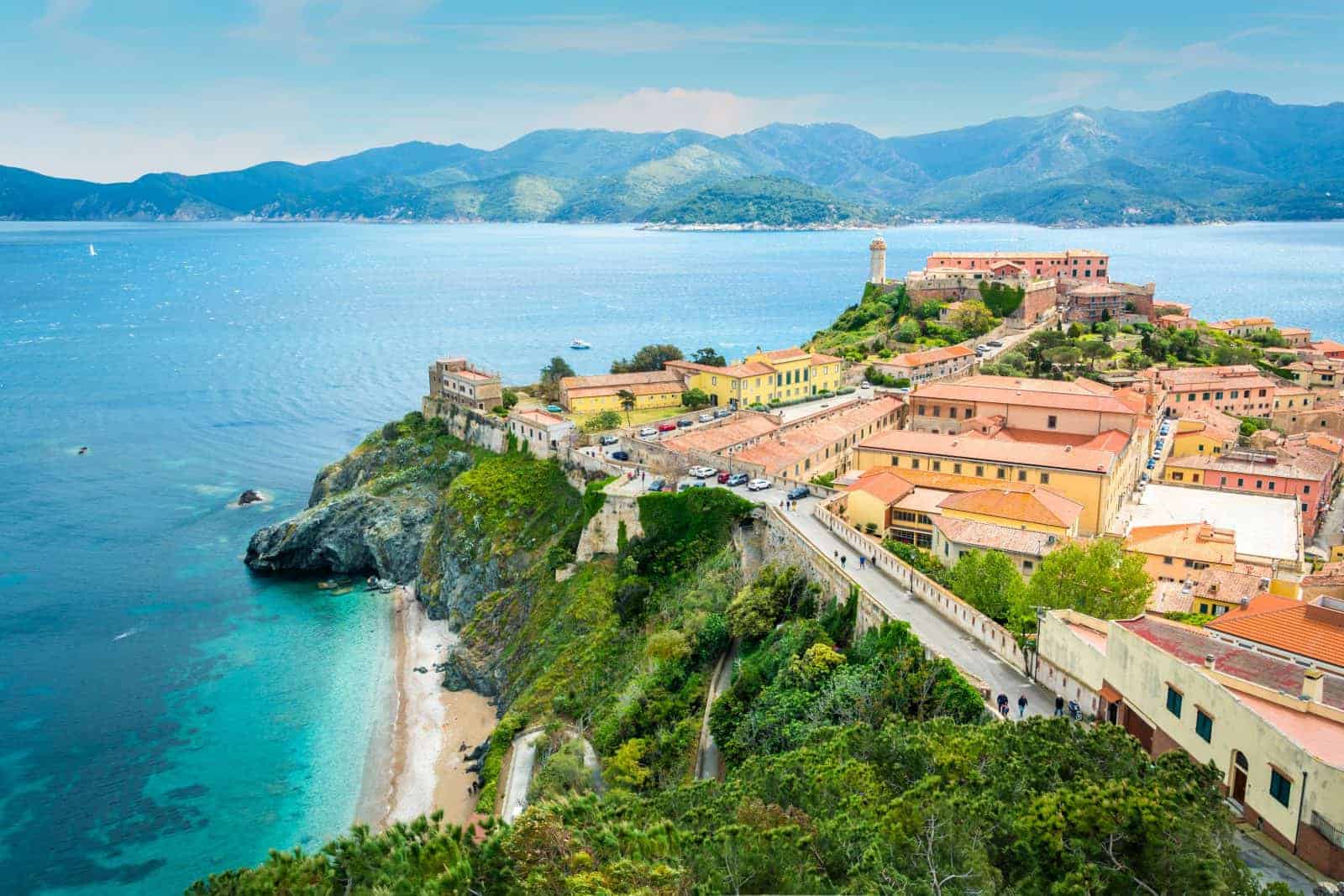
Montecristo Island
Content
Montecristo is the most mysterious island in Tuscany: This granite island between Elba and Giglio is a strictly protected nature reserve and almost uninhabited. It was made world-famous by Alexandre Dumas' novel "The Count of Monte Cristo." You can only visit Montecristo on a few guided tours offered by the national park, which are quickly booked up each year.
Visiting Montecristo – At a glance (as of 2026)
- Only with a park guide: 23 dates from March 21st to September 20th, 2026, max. 75 people per date.
- Departure: usually from Piombino Marittima with a stopover in Porto Azzurro (Elba); on May 22nd and June 12th from Porto Santo Stefano with a stop on Giglio.
- Price 2026: €140 per person including boat trip and guided tour (Monte della Fortezza summit tour: €180).
- Booking: Namely and online at Info Park (parcoarcipelago.info/montecristo), since February 9, 2026.
- Regulate: Minimum age 12 years, swimming prohibited, no pets.
Where is Montecristo located?
View larger mapMontecristo lies in the Tyrrhenian Sea, roughly halfway between Elba and Corsica, and south of Pianosa . The island is 10,39 km² in size and rises steeply to 645 m (Monte della Fortezza). The coastline is almost entirely rocky; the only landing place is the bay of Cala Maestra on the west coast.
Visiting Montecristo: Tours, prices and rules 2026
Montecristo has been a nature reserve since 1971 and is now part of the Tuscan Archipelago National Park. Previously, very few permits were issued; now the park organizes fixed visiting dates each year with online booking. For 2026, 1.725 places were available.
| Offer 2026 | Details |
|---|---|
| Appointments | 23 dates, March 21 to September 20, 2026 |
| Departure | Piombino Marittima with a stop in Porto Azzurro (Elba); May 22 and June 12 from Porto Santo Stefano with a stop on Giglio |
| Participants | Maximum 75 people per appointment |
| Price | €140 per person (including boat trip and park guide); €60 for residents of the archipelago municipalities (limited availability) |
| Summit tour | April 11 and September 6: Ascent of Monte della Fortezza (645 m), max. 12 experienced hikers, €180 |
| minimum age | 12 years |
What you should know
- The booking is personal and is made online by credit card via parcoarcipelago.info/montecristo.
- Strict rules apply on the island: You stay with the group and follow park guides and Carabinieri forest rangers.
- Swimming is prohibited, and dogs and other pets are not allowed. So forget about a beach holiday here.
- There is no medical care on the island – sure footing, water and sun protection are essential.
- The spots are usually booked up quickly. The park typically publishes the dates for the following year at the beginning of the year. islepark.it.
How to book a visit to Montecristo
- Check dates: The national park publishes the visiting dates at the beginning of the year on islepark.itBookings for 2026 started on February 9th at 9am.
- Book online: Reservations are made via the Info Park portal (parcoarcipelago.info/montecristo) – specifically for each participant and with immediate payment by credit card.
- Be quick: There is no waiting list. For residents of the archipelago communities, there was a quota of 100 places at €60 in 2026; any unclaimed places were then released for general sale.
- Plan your journey to the port: Most tours depart from Piombino Marittima. Those vacationing on Elba should board at the stopover in Porto Azzurro. Ferry information can be found at [website address]. Arrival to Elba.
What to expect on the island
All boats dock in Cala Maestra bay, the only landing place. There you'll find the Villa Reale with its small natural history museum and the garden designed by Watson-Taylor. From here, three marked, rather challenging trails lead inland. It's about a 1 hour 10 minute walk to the ruins of the San Mamiliano monastery, and from there another 40 minutes or so to the Grotta del Santo, the hermitage of Saint Mamilianus. Sturdy footwear, good physical condition, and plenty of drinking water are essential.
Visitors must stay on the designated paths; picking plants and taking stones is prohibited. Overnight stays are not permitted on Montecristo – all visits are day trips.

Nature on Montecristo
The island consists mostly of grey to pinkish granite and is shaped like a pyramid. Because Montecristo has been virtually untouched for decades, its natural environment is particularly pristine: maquis shrubland with tree heath, rosemary, rockroses, and strawflowers covers the slopes. In 1988, the island was awarded the European Diploma of Protected Areas by the Council of Europe.
Animals: Wild goats, frogs and seabirds
The Montecristo wild goat is famous, being the only wild goat population in Italy; it was probably brought to the island by seafarers in antiquity. Also living here are the Sardinian disc-tongued frog (Discoglossus sardus), a rare frog species from Sardinia and Corsica, and a unique subspecies of wall lizard. The island is an important resting place for migratory birds and a breeding ground for seabirds.
Among the special features are a unique form of the asp viper and a significant breeding colony of the Mediterranean shearwater (Puffinus yelkouan). Because introduced rats were preying on the chicks, the national park controlled them in 2010 as part of the EU project LIFE Montecristo. The tree of heaven, introduced by Watson-Taylor in the 19th century, is also being controlled as an invasive species. The sea lavender (Limonium montis-christi), which grows only here, is endemic.
The sea around Montecristo
The entire island and the sea within a radius of about one kilometer belong to the strictest protection zone of the national park. Neptune grass meadows grow on the seabed. Until the 1970s, monk seals still lived here. Montecristo lies within the Pelagos Sanctuary for whales and dolphins.
The story of Montecristo
According to legend, Saint Mamilianus retreated to the island as a hermit in the 5th century, living in a cave – the Grotta del Santo, which can still be visited today – and named it "Mons Christi". Legend has it that he defeated a dragon there; a spring is said to have sprung up at this spot.
Monastery, pirates and kings
- 7th century: Founding of the monastery of San Mamiliano, whose ruins can still be seen.
- 1553: The Ottoman corsair Dragut attacks the monastery and abducts the monks – thus ending monastic life.
- 1852: The Englishman George Watson-Taylor bought the island and established a botanical garden at Cala Maestra; the Villa Reale dates from this period and is now the headquarters of the forestry administration with a small natural history museum.
- 1869 / 1878: The Italian state bought the island and in 1878 established a penal colony as an extension of the prison of Pianosa .
- 1889 / 1896: Marchese Carlo Ginori turned the island into a hunting ground; the future King Victor Emmanuel III spent his honeymoon here in 1896 and subsequently used the island as a royal hunting area.
- 1971: Montecristo will become a nature reserve.
The Count of Monte Cristo
The island became world-famous through Alexandre Dumas' 1844 novel " The Count of Monte Cristo ." In it, the hero Edmond Dantès finds a legendary treasure on Monte Cristo. To this day, no real treasure has been found – even though legends abound about the monks' hidden riches.
Alexandre Dumas himself never actually set foot on Montecristo. The island only served as a setting for his novel – yet to this day, its image as a mysterious treasure island is shaped by the novel.
Montecristo or Monte Cristo?
The Italian name is Montecristo, while in German, the spelling of the novel title "Monte Christo" is particularly well-known. Both refer to the same island. The name dates back to the hermits of the 5th century, who called the island "Mons Christi" (Mountain of Christ). In antiquity, it was called Oglasa by the Greeks and Mons Jovis by the Romans; the Romans quarried granite here.
Montecristo and the other islands of the archipelago
Visits to Gorgona and Pianosa are similarly strictly regulated . Those visiting Montecristo from Piombino can easily combine the trip with a stay on Elba or in Piombino itself.
Frequently asked questions about the island of Montecristo
Is it possible to visit the island of Montecristo?
Yes, but only on guided tours offered by the Tuscan Archipelago National Park. In 2026, there are 23 dates available between March 21st and September 20th, with a maximum of 75 participants per tour. Bookings are made online and must be made by name through Info Park.
How much does a visit to Montecristo cost?
In 2026, the tour costs €140 per person, including the boat trip and park guide. The summit tour to Monte della Fortezza costs €180.
From where do the boats go to Montecristo?
Most tours depart from Piombino Marittima with a stopover in Porto Azzurro on Elba. On two dates in 2026 (May 22nd and June 12th), the tours will start in Porto Santo Stefano with a stop on Giglio.
Is it permitted to swim or stay overnight on Montecristo?
No. Swimming is prohibited, overnight stays are not possible, pets are not allowed, and children must be at least 12 years old.
Who lives on Montecristo?
Only two nature reserve wardens live permanently on the island, along with forest rangers working in shifts. There are no hotels, shops, or restaurants.
Was there a prison on Montecristo?
Yes. From 1878, the island housed a penal colony as an extension of the Pianosa prison. Later, Montecristo became a royal hunting reserve, and since 1971 it has been a nature reserve.
Does the treasure of the Count of Monte Cristo exist?
The treasure originates from the novel by Alexandre Dumas (1844), who himself never set foot on the island. No real treasure has ever been found, although there are legends about the riches of the monks of San Mamiliano.