
Colle di Val d'Elsa – Crystal City in the Elsa Valley
Content
Colle di Val d'Elsa is located in the province of Siena , about 25 kilometers northwest of Siena and only about 15 kilometers from San Gimignano. Many tourists simply drive past it on their way to Siena or Volterra – but the town, with its medieval upper town, the turquoise Elsa River, and its long tradition as the "City of Crystal," is well worth a visit.
Where is Colle di Val d'Elsa located?
The City of Crystal
Colle ist seit Jahrhunderten für die Herstellung von Kristallglas bekannt und wird deshalb auch „Città del Cristallo“ genannt. In der Stadt gibt es ein Kristallmuseum und zahlreiche Geschäfte, in denen Sie Gläser, Karaffen und Schalen direkt kaufen können. Schon im 15. Jahrhundert wurde hier außerdem eine der frühen Buchdruckereien Italiens betrieben.
Cristallo Museum: Opening Hours and Prices
According to the city, the Crystal Museum is the only museum in Italy entirely dedicated to the history and production of crystal glass. It is located a few steps from Piazza Arnolfo di Cambio on the grounds of the former Boschi glassworks, beneath its old chimney. The exhibition ranges from medieval artifacts – glassmaking has been documented in Colle since 1331 – to the first crystal manufactory from 1820, and on to modern designs. On the lower floor, videos, eyewitness accounts, and tools recount the daily lives of glassworkers; an interactive exhibit on earth, water, fire, and air demonstrates how raw materials are transformed into crystal. The museum underwent a complete redesign in 2023.
| Crystal Museum | Data (as of 2026) |
|---|---|
| Address | Via dei Fossi 8a (former Boschi area), Colle di Val d'Elsa |
| Opening hours | Tue, Thu, Fri, Sat and Sun 14–19 pm; Mon and Wed closed |
| Admission | 6 €, reduced 4 € |
| Combined ticket | 3 museums in the city: €12, concession €8 (valid for 48 hours) |
| Phone | +39 0577 912776 |
The combined ticket also grants access to the Museo San Pietro (Museum of Sacred and Urban Art in a former monastery in the upper town) and the "Ranuccio Bianchi Bandinelli" Archaeological Museum in the Palazzo Pretorio, which houses a significant Etruscan collection. The archaeological park of Dometaia, with its Etruscan necropolis, is also part of the museum complex.
Arnolfo di Cambio – the city's most famous son
Der berühmteste Sohn der Stadt ist der Baumeister und Bildhauer Arnolfo di Cambio, der im 13. Jahrhundert in Colle geboren wurde. Er entwarf in Florenz unter anderem den Dom Santa Maria del Fiore und den Palazzo Vecchio. Ihm ist der zentrale Platz der Unterstadt gewidmet, die Piazza Arnolfo di Cambio.
In the upper town stands the medieval Casa-torre di Arnolfo , the residential tower house where, according to tradition, Arnolfo was born – one of the few tower houses in the city that have retained their original form.
Lower town and upper town
Colle consists of two parts: the newer lower town (Colle Bassa) in the valley and the medieval upper town (Colle Alta) on the hill. From the lower town, you walk up via steps and steep alleyways.
Parking and elevator to the upper town
The glass elevator, designed by architect Jean Nouvel, normally connects the lower town with the Baluardo observation deck in the upper town. However, it has been out of service since March 2021; the city is planning its restoration, but a reopening date of June 2026 had not yet been set. The access tunnel is a former air-raid shelter from the Second World War and houses the sculpture "Red Girl" by artist Kiki Smith.
If you're driving, the best place to park is in one of the parking lots around the lower town, then walk up. Alternatively, drive from the west towards Porta Nuova: there's a larger parking lot below the city gate, from which a footpath leads into the old town. If you're traveling by campervan, you should avoid the narrow streets of the upper town.
Sights in Colle Alta
- Porta Nuova: das wuchtige Stadttor mit zwei runden Türmen aus dem 15. Jahrhundert, Giuliano da Sangallo zugeschrieben, blickt Richtung Volterra.
- Porta Nuova: The imposing city gate with two round towers from the 15th century, attributed to Giuliano da Sangallo, faces towards Volterra.
- Via del Castello: The main street of the upper town with palazzi, family towers and churches.
- Dom Santi Alberto e Marziale: die Konkathedrale aus dem 17. Jahrhundert bewahrt die Reliquie des „Heiligen Nagels“ (Sacro Chiodo).
- Palazzo Campana: The Renaissance palace of Giuliano di Baccio d'Agnolo with its arched gateway is considered a landmark of the city; in front of it, a bridge spans the gap to the oldest part of town, the "Castello".
- St. Peter's Museum and Archaeological Museum in the Palazzo Pretorio (see combination ticket above).
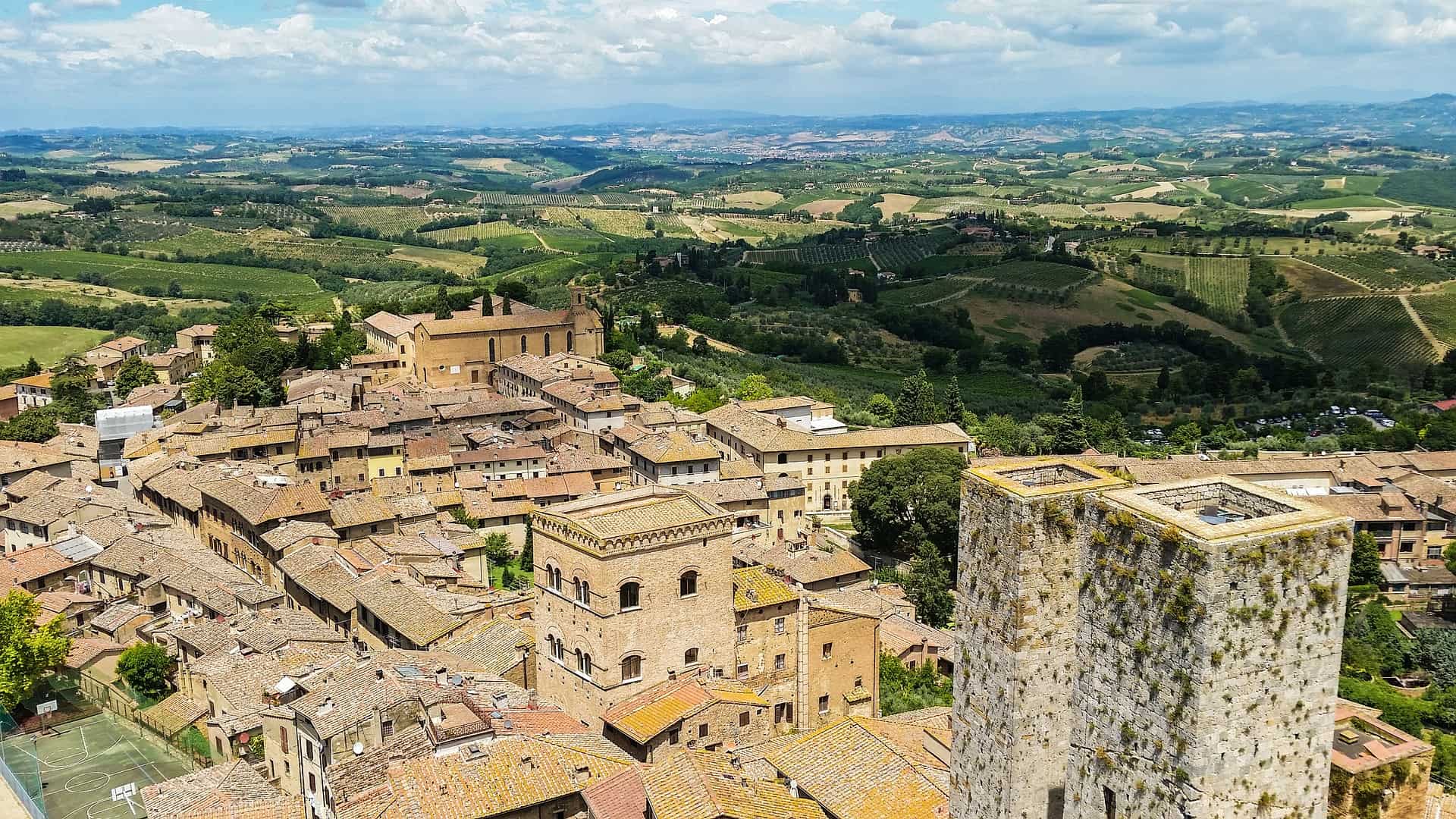
In der Oberstadt führt die Via del Castello vorbei an Palazzi, Türmen und Kirchen, darunter der Dom aus dem 17. Jahrhundert. Durch das Stadttor Porta Nova betreten Sie die Altstadt von Westen. Vom Palazzo Campana mit seinem Torbogen blicken Sie über die Dächer und das grüne Elsatal.
The Sentierelsa: Hiking along the turquoise river

A special experience awaits on the Sentierelsa, a well-maintained hiking trail approximately 4 kilometers long in the Upper Elsa River Park (Parco fluviale dell'Alta Val d'Elsa). It runs from the hamlet of Gracciano to the Ponte di Spugna bridge, is directly accessible from the old town, and is part of the Via Francigena. The calcareous water shimmers turquoise, and along the way, there are boardwalks, wooden bridges, steps, small waterfalls, and natural pools known as caldane. The highlight is the Diborrato : here, the Elsa plunges about 15 meters into a pool below.
Practical tips for the Sentierelsa
- The path is freely accessible and there is no entrance fee; there are no toilets or changing rooms along the way.
- You should plan half a day for the round trip (approx. 8 km) including swimming breaks.
- Bring sturdy footwear or water shoes – in some places you have to walk over stepping stones or through water.
- The path is very popular in summer and on weekends; it is quieter early in the morning or during the week.
- Those who only want to go to Diborrato should start closer to the waterfall in the area of the San Marziale bridge.
- Be careful of rocks below the water's surface when swimming; jumping from the waterfalls is dangerous.
Those who prefer cycling can use the cycle path on the former railway line between Colle di Val d'Elsa and Poggibonsi.
Practical information for your visit
When is the market in Colle di Val d'Elsa?
The weekly market in Colle di Val d'Elsa takes place every Friday morning in the heart of the lower town, on Piazza Arnolfo di Cambio and in the surrounding streets. Most stalls set up early in the morning and pack up again around noon – so you'll have the widest selection if you come in the morning.
Everything you'd expect from a typical Tuscan weekly market is on offer: regional fruits and vegetables, cheeses like Pecorino, sausages and ham, bread, olive oil , as well as clothing, shoes, household goods, and fabrics. It's the perfect place to stock up for a picnic by the Elsa River or for your holiday apartment.
Parking on market day
Because the market takes place in the central square, the town center is crowded on Friday mornings. It's best to park in one of the larger parking lots on the edge of the lower town, such as the Fontibona parking lot – although it fills up quickly on market days – or a little further away at the Fornacina parking lot, and then walk the last few minutes. If you're traveling by campervan, you should avoid the narrow streets of the town center on market days.
For other market days in the area, for example in San Gimignano (Thursdays) or Siena (Wednesdays), please see our overview of markets in Tuscany.
Excursion destinations in the area
Colle is a good location to explore the center of Tuscany:
- Monteriggioni (approx. 12 km): the completely walled castle village with its towers.
- San Gimignano (approx. 15 km): the city of medieval family towers, see our City tour San Gimignano.
- Siena (approx. 25 km): including the Piazza del Campo, see Siena.
- Volterra (approx. 30 km): the Etruscan city on the hill, see Volterra.
- ChiantiWineries like Castello di Fonterutoli near Castellina in Chianti invite you to tastings; more information at Chianti in the heart of Tuscany.
Food, drink and accommodation
Around Piazza Arnolfo di Cambio and in the upper town, you'll find bars, trattorias, and restaurants where you can enjoy Tuscan cuisine and wines from the nearby Chianti region. In the evenings, the square becomes a meeting place for families: children play while adults enjoy an aperitivo. Accommodation options include small hotels in the old town, holiday apartments, or an agriturismo in the surrounding area.
Find accommodation in Colle di Val d'Elsa
Frequently asked questions about Colle di Val d'Elsa
When and where is the market in Colle di Val d'Elsa?
Every Friday morning in Piazza Arnolfo di Cambio and the surrounding streets in the lower town.
How do I get to the upper town, Colle Alta?
On foot via stairs and alleyways from the lower town, or by car to the parking lot below the Porta Nuova. The elevator to the Baluardo has been out of service since March 2021 (as of June 2026).
When is the Crystal Museum open and how much does it cost?
The Museo del Cristallo is open Tuesdays, Thursdays, Fridays, Saturdays, and Sundays from 14 pm to 19 pm. Admission costs €6, concessions €4; a combined ticket for three museums costs €12 (as of 2026).
Where does the Sentierelsa begin and how long is it?
The approximately 4 km long hiking trail along the Elsa River begins in the hamlet of Gracciano and leads to the Ponte di Spugna bridge. Bring water shoes, as the trail crosses water in some sections.
Who was Arnolfo di Cambio?
Der im 13. Jahrhundert in Colle geborene Baumeister und Bildhauer entwarf in Florenz den Dom Santa Maria del Fiore; ihm wird auch der Palazzo Vecchio zugeschrieben. Sein Geburtshaus, die Casa-torre di Arnolfo, steht in der Oberstadt.
What is there to do near Colle di Val d'Elsa?
Worthwhile destinations nearby include Monteriggioni (approx. 12 km), San Gimignano (approx. 15 km), Siena (approx. 25 km), Volterra (approx. 30 km) and the Chianti wineries.