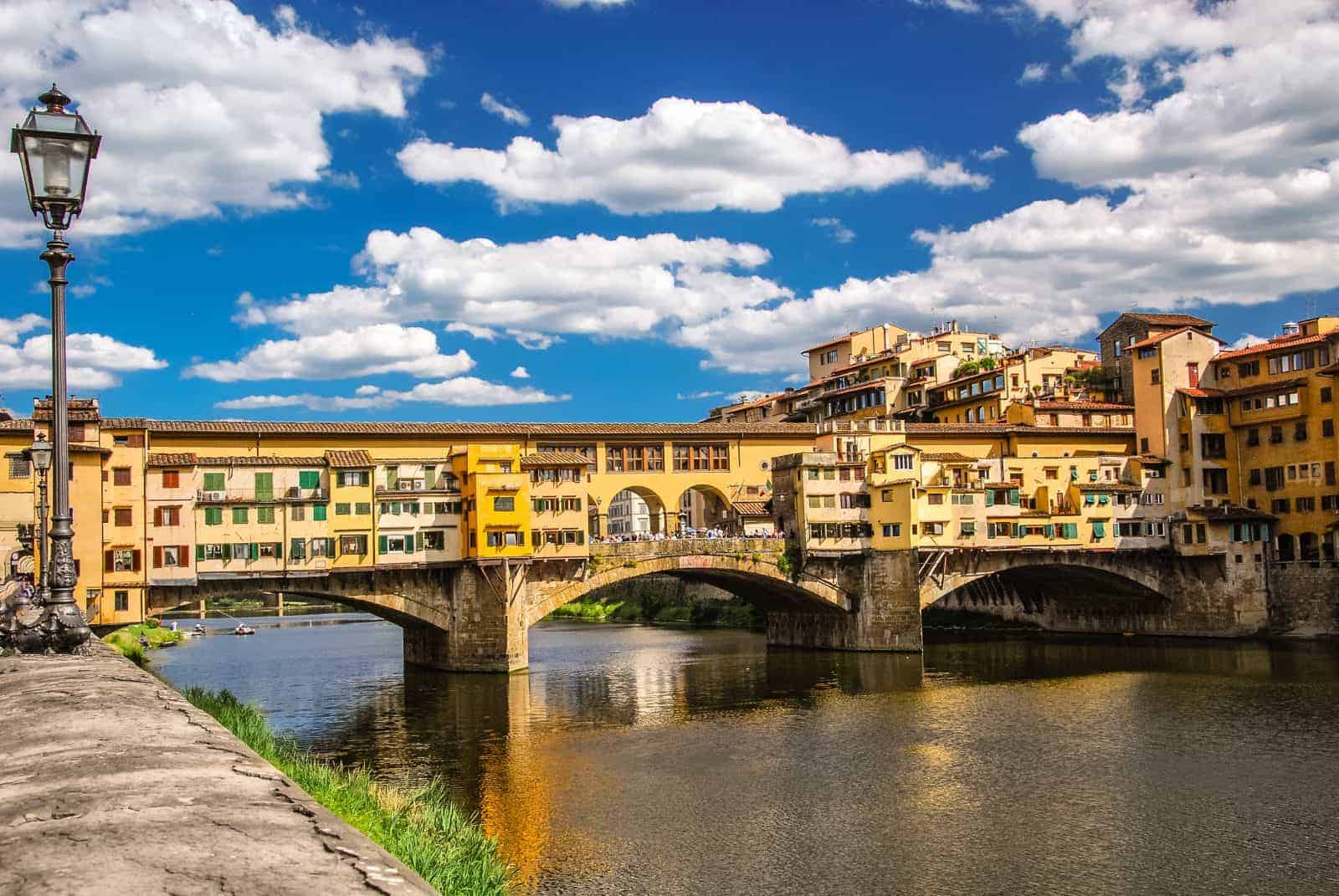

The Ponte Vecchio in Florence - a stone past
Content
The Ponte Vecchio in Florence is one of the oldest segmental arch bridges in the world, with its earliest traces dating back to Roman times. When I first saw this famous bridge in Florence, I was immediately captivated by its historical significance. Indeed, it was completed in 1345 after approximately ten years of construction and has witnessed numerous historical events ever since.
What I find particularly impressive is that the Ponte Vecchio is the only bridge in all of Florence that was spared the destruction inflicted by German troops during the Second World War. The medieval structure of the bridge, which rests on three solid arches, has essentially preserved its original form from the 14th century. By the way, did you know that today's goldsmiths and jewellers have only had their shops on the Ponte Vecchio since the end of the 16th century? Before that, butchers were based there, who had to make way because of their unpleasant smells, which offended aristocratic noses.
In this article, we will take you on a walk across the Ponte Vecchio and discover together its fascinating 700-year history , architectural features and cultural significance.
Ponte Vecchio at a glance
- Florence's oldest bridge, completed in 1345; 84 m long with three segmental arches
- Shops of goldsmiths and jewelers since 1593
- Open to the public and free of charge – around the clock
- Vasari Corridor above: reopened since December 2024, ticket including Uffizi Gallery €43 (as of 2026)
The beginnings of the Ponte Vecchio
Even in Roman times, people recognized the need for a crossing over the Arno. The history of the Ponte Vecchio therefore stretches back much further than its current appearance suggests.
First bridge in Roman times
Even in Roman times, a bridge crossed the Arno at this narrowest point. The predecessor of today's Ponte Vecchio was for a long time a wooden structure on stone pillars – and thus defenseless against the Arno's floods.
Over the centuries, the bridge had to be rebuilt several times. According to historical sources, it was destroyed by a flood in 1117, among other events. Subsequent reconstructions also failed to withstand the forces of nature.
Reconstruction after the flood of 1333
The year 1333 marked a turning point in the history of Florence's famous bridge. A devastating flood inundated large parts of the city and completely destroyed the then wooden bridge. The effects of this natural disaster must have been so severe that the city's authorities decided to take comprehensive protective measures.
The first step was to secure the banks of the Arno with high walls to better contain future flooding. Only after this extensive work was completed could the reconstruction of the bridge begin. This time, a much more stable stone structure was chosen instead of the previous wooden bridge.

Completion in 1345
Construction work on the new stone bridge finally began in 1335. The construction of the Ponte Vecchio was an ambitious project that, depending on the source, took between ten and twelve years. The actual architect of the bridge remains unclear to this day. Historical sources primarily mention two names:
- Taddeo Gaddi, a student of the famous painter Giotto di Bondone
- Neri di Fioravanti, a well-known Florentine architect
After its completion in 1345, small shops were immediately built on both sides of the bridge. These were lined up in a continuous row, with their rear sections jutting out over the bridge like balconies. This characteristic arrangement of shops characterizes the Ponte Vecchio to this day and makes it a unique landmark of Florence.
Architecture and special features of the bridge
An architectural masterpiece, the Ponte Vecchio has captivated visitors for centuries. While other medieval bridges of its time relied on semicircular arches, this bridge broke new ground in the engineering of its day.
Three arches and medieval structure
The Ponte Vecchio's most outstanding architectural feature is its construction as a segmental arch bridge , considered one of the oldest of its kind in the world. With an impressive total length of 84 meters and a width of 32 meters, it majestically spans the Arno River. Particularly noteworthy are the three shallow segmental arches, whose spans measure 27, 30, and 27 meters respectively.


This innovative construction differs significantly from the Roman bridge-building model, which typically featured many small arches. In fact, this method was groundbreaking for the 14th century, as the flatter segmental arches with rise heights of only 3,90 to 4,40 metres got by with less. This advanced architecture brought a decisive advantage: in the event of high water, the water could drain away better without endangering the bridge piers.
The distinctive shops of the Ponte Vecchio extend far beyond the actual bridge structure and are partially supported by additional struts. This bold construction gives the bridge its unique appearance and makes it one of the most fascinating sights in Tuscany.
The Cellini bust in the middle
In the middle of the Ponte Vecchio, on the western side, there is a special treasure: the bust of Benvenuto Cellini (1500–1571), arguably the most famous goldsmith of Florence. This impressive monument was created by the sculptor Raffaello Romanelli and solemnly unveiled in the year 1901 – on the occasion of the 400 birthday of the great artist.
Cellini's depiction is remarkably romantic: with a furrowed face, flowing beard, and proud posture, he gazes across the Arno. The elaborately designed base incorporates motifs borrowed from the base of Cellini's masterpiece "Perseus" and features an original shell-shaped basin in which the fountain's water collects.
The monument's inscription proudly proclaims: "To Benvenuto Cellini – Master – The Goldsmiths of Florence." However, a more fitting location for this tribute could hardly have been found than the Ponte Vecchio, where goldsmiths have plied their trade for centuries.

Viewpoints over the Arno
What makes the Ponte Vecchio special are its unique viewpoints. Unlike most bridges, which are lined with buildings throughout, the Ponte Vecchio offers open areas in its center from which visitors can admire the Arno.
On the eastern side, three arcade-like arches offer a picturesque view upstream. On the western side, a terrace with the Cellini bust offers a breathtaking panoramic view downstream. From this central vantage point, not only the river but also the banks of the Arno and the other bridges of Florence can be admired.
These open spaces divide the shops on the bridge into four blocks—two on each side—and interrupt the otherwise continuous row of shops. In addition, the Vasari Corridor, which runs above the eastern row of shops, features three panoramic windows that were opened in 1938 to mark Hitler's visit to Florence.
Anyone visiting the shops on the bridge should definitely pause at these viewpoints. Especially at sunset, the bridge offers an unforgettable sight when the golden light falls on the Arno and the surrounding buildings – a perfect photo opportunity and a moment to linger.

From slaughterhouse to gold mile
Strolling across the Ponte Vecchio today, it's hard to imagine that very different smells and sounds once dominated daily life here. The history of Florence's famous bridge is marked not only by architectural brilliance but also by a remarkable economic transformation.
Butchers and tanners in the Middle Ages
At first, it was by no means noble goldsmiths who offered their wares on the Ponte Vecchio. In the 14th century, after the bridge was completed, mainly butchers and tanners settled there. These trades chose the bridge for a practical reason: they could dispose of their waste and wastewater directly into the Arno flowing below. In fact, this practice was not unusual at the time – in other European cities such as Nuremberg, craftsmen also made use of similar opportunities.
Initially, it wasn't noble goldsmiths who offered their wares on the Ponte Vecchio. In the 14th century, after the bridge's completion, butchers and tanners primarily settled there. These tradespeople chose the bridge for a practical reason: they could dispose of their waste and wastewater directly into the Arno River flowing below. In fact, this practice wasn't unusual at the time – craftsmen in other European cities, such as Nuremberg, made similar use of this method.
Decree of Ferdinand I and resettlement
The situation changed drastically in the late 16th century. The stench and pollution became unbearable even for the Florentines – especially for the ruling Medici family. Since the Medici regularly had to use the Vasari Corridor, which had been built 1565 above the east side of the Ponte Vecchio to get from their Palazzo Vecchio to the Palazzo Pitti, they were particularly exposed to the smell.
The situation changed drastically in the late 16th century. The stench and pollution became unbearable even for the Florentines—but especially for the ruling Medici family. Since the Medici regularly had to use the Vasari Corridor, built in 1593 over the east side of the Ponte Vecchio, to get from their Palazzo Vecchio to the Palazzo Pitti, they were particularly exposed to the odor.
- The butchers and tanners had to leave the bridge
- Only goldsmiths and jewelers were allowed to operate their businesses on the bridge
- These did not produce any foul-smelling waste
This decree marked a turning point in the history of the shops on the bridge: to this day, jewelers and goldsmiths shape the image of the Ponte Vecchio.
Goldsmith shops today
After extensive cleanup work, a new era began for the bridge. Goldsmiths and jewelers set up their workshops and established a tradition that would last for more than four centuries. The distinctive shops were divided into four blocks, each offering traditional and handcrafted products.
Nowadays, the small, often crooked shops that seem to cling to the sides of the bridge like swallows' nests are a distinctive feature of the Ponte Vecchio. Some were created through unauthorized extensions by previous owners who wanted to make the best use of the available space – these idiosyncratic constructions give the bridge its unique, slightly chaotic appearance.
During the Renaissance, the Ponte Vecchio evolved not only into a connection between the banks of the Arno, but also into a cultural meeting place for artists, artisans, and intellectuals. This vibrant tradition continues to this day, transforming the once foul-smelling bridge into a shining jewel of the Florentine cityscape.


The Vasari Corridor: Secret Passage of the Medici
Above the busy Ponte Vecchio lies an architectural secret that many visitors overlook: the Vasari Corridor – a private passageway that once served Florence's most powerful family.
Built by Giorgio Vasari in 1565
In 1565, Grand Duke Cosimo I de' Medici commissioned the architect Giorgio Vasari to build a secret passageway to celebrate the wedding of his son, Francesco, to Joanna of Austria. The impressive structure was completed in just five months, even though Vasari was also overseeing work on the Palazzo Vecchio and the construction of the Uffizi Gallery at the same time. This astonishing feat demonstrates not only the architect's efficiency but also the power and influence of the Medici family.
Connection between Palazzo Vecchio and Palazzo Pitti
The approximately 750-meter-long corridor connects the Palazzo Vecchio with the Palazzo Pitti, crossing the Arno River via the Ponte Vecchio. Beginning in the Uffizi Gallery, the passageway initially runs along the riverbank before crossing the famous bridge. Remarkably, the corridor had to bypass the medieval Mannelli family tower, as they were the only ones to resist its demolition. Of particular interest: in the Church of Santa Felicita, the corridor opens onto a gallery that allowed the Grand Ducal family to attend Mass.
Use by the Medici family
The original function of the corridor system was clearly defined: to allow the Medici family to move unnoticed and safely through the city. Indeed, the direct route through the city center posed a significant security risk for the Tuscan Grand Duke. The corridor, however, provided private VIP access—a Renaissance security tunnel, in a sense. Small windows along the entire route provide unique views of the city and the river.
Artworks and current access
Previously, numerous paintings hung in the corridor, most recently the Uffizi's famous collection of artists' self-portraits. After an eight-year closure and a restoration costing around 10 million euros, the Vasari Corridor reopened to visitors on December 21, 2024 – deliberately simple, as an "air passage" with a terracotta floor and windows overlooking the city. The route leads in one direction from the Uffizi Gallery, across the Ponte Vecchio, to the Boboli Gardens.
| Vasari Corridor | Details (as of 2026) |
|---|---|
| Opening hours | Tuesday to Sunday, first group 10:15 am, last group 16:35 pm |
| Closed | Mondays and on the Uffizi's closing days |
| Admission | €43 if purchased on the day of the visit or €47 in advance, both prices include admission to the Uffizi Gallery. |
| Booking | Reservations required, max. 5 tickets per booking |
The corridor is visited in groups of no more than 25 people – so please book well in advance. All entrance fees for the Uffizi Gallery, the Duomo, and the Accademia can be found in our Florence travel guide.
Find accommodation in Florence
Cultural significance and today's experience
The Ponte Vecchio is not only an architectural gem, but also a symbol of cultural continuity and romantic tradition. Over the centuries, it has evolved into a place that holds deep emotional significance for locals and visitors alike.
Survival in World War II
The bridge carries a unique historical legacy: During World War II, the Ponte Vecchio was the only bridge in Florence to escape destruction. All other bridges were blown up during the retreat of German troops in August 1944. However, accounts of its survival differ. Some sources claim that Hitler personally ordered the bridge to be spared, while others attribute its rescue to the German consul, Gerhard Wolf. In reality, it was the surrounding buildings that were destroyed to block access to the bridge.
Love locks and romantic symbolism
For about a century, the bridge has been the scene of a special tradition: lovers attach padlocks to the bridge and throw the key into the Arno River to seal their eternal love. This tradition is said to have originated with graduates of the San Giorgio Medical Academy, who attached their locker locks to the bridge after graduation. Today, the authorities ensure that not too many locks are attached to protect the bridge's safety.
Tips for a visit at sunset
The Ponte Vecchio is particularly impressive at sunset. From the Piazzale Michelangelo viewing platform, you'll be treated to a breathtaking view as the sun bathes the city, the Duomo, and the bridge in golden, pink, and finally purple light. Alternatively, you can enjoy the sunset from the Ponte Santa Trinita, which offers a perfect view of the famous bridge. After sunset, an extraordinary atmosphere arises as many people linger on the neighboring bridges to enjoy a quiet moment.
Our tip
- Come early in the morning or in the evening – there will be significantly fewer tourists on the bridge.
- You have a wonderful view of the Arno and the city from Piazzale Michelangelo on the other side of the river.
- More personal Florence tips: Florence travel guide.
Practical tips for your visit
- Space: The Ponte Vecchio is a pedestrian bridge and can be crossed free of charge at any time. It connects the area around the Uffizi Gallery with the Oltrarno district and the Pitti Palace.
- Best time: Early in the morning it's still quiet. During the day, especially in peak season, it gets very crowded – watch out for pickpockets.
- Photo spots: The best views of the bridge can be had from the Ponte Santa Trinita and from Piazzale Michelangelo, especially at sunset.
- Love locks: Please do not attach locks – they are regularly removed.
- Combine: The Uffizi Gallery, Piazza della Signoria, and Pitti Palace are within walking distance. Our guidebook Florence helps with planning; also worthwhile for a day trip Siena and Pisa.
Tickets & Tours
- Uffizi Gallery and Vasari Corridor: Tickets and guided tours – Timed-entry tickets for the Uffizi Gallery, some in combination with the Vasari Corridor.
- Guided city tours in Florence – guided tours, which usually also include the Ponte Vecchio.
Conclusion
The Ponte Vecchio has stood as a living testimony to Florentine history for 700 years. During this time, it has undergone numerous transformations – from a simple Roman bridge to a medieval butcher's mile to a gleaming goldsmith's alley. I find its architectural durability, which defied even the destruction of World War II, particularly fascinating.
My personal tip is: Be sure to visit the Ponte Vecchio twice—once during the day to enjoy the shimmering golden displays and the hustle and bustle, and once at sunset, when the ancient stones are bathed in warm light. These different perspectives reveal the true character of this extraordinary bridge.
Frequently asked questions about the Ponte Vecchio
What makes the Ponte Vecchio so special?
It is one of the oldest segmental arch bridges in the world (completed in 1345), still carries inhabited shops and the Vasari Corridor, and was the only Florentine Arno bridge that was not blown up in 1944.
Is there an entrance fee to cross the Ponte Vecchio?
No. The bridge is a public pedestrian bridge and is accessible free of charge at all times. Only the Vasari Corridor above the shops requires a toll.
Why are there goldsmiths on the Ponte Vecchio?
In 1593, Grand Duke Ferdinand I de' Medici banished butchers and tanners from the bridge, permitting only goldsmiths and jewelers. This tradition continues to shape the bridge to this day.
Is it possible to visit the Vasari Corridor?
Yes, it's been open again since December 2024. As of 2026, the ticket including the Uffizi Gallery costs €43 if purchased on the day of your visit or €47 in advance; reservations are mandatory, and it's open Tuesday to Sunday.
How long is the Ponte Vecchio?
The bridge is 84 meters long and 32 meters wide and rests on three shallow arches with spans of 27, 30 and 27 meters.
Why wasn't the Ponte Vecchio blown up during World War II?
This has not been definitively clarified. Records show an order from Hitler to spare the bridge and the intervention of the German consul, Gerhard Wolf. Instead, in 1944, the houses at both approaches were blown up.