



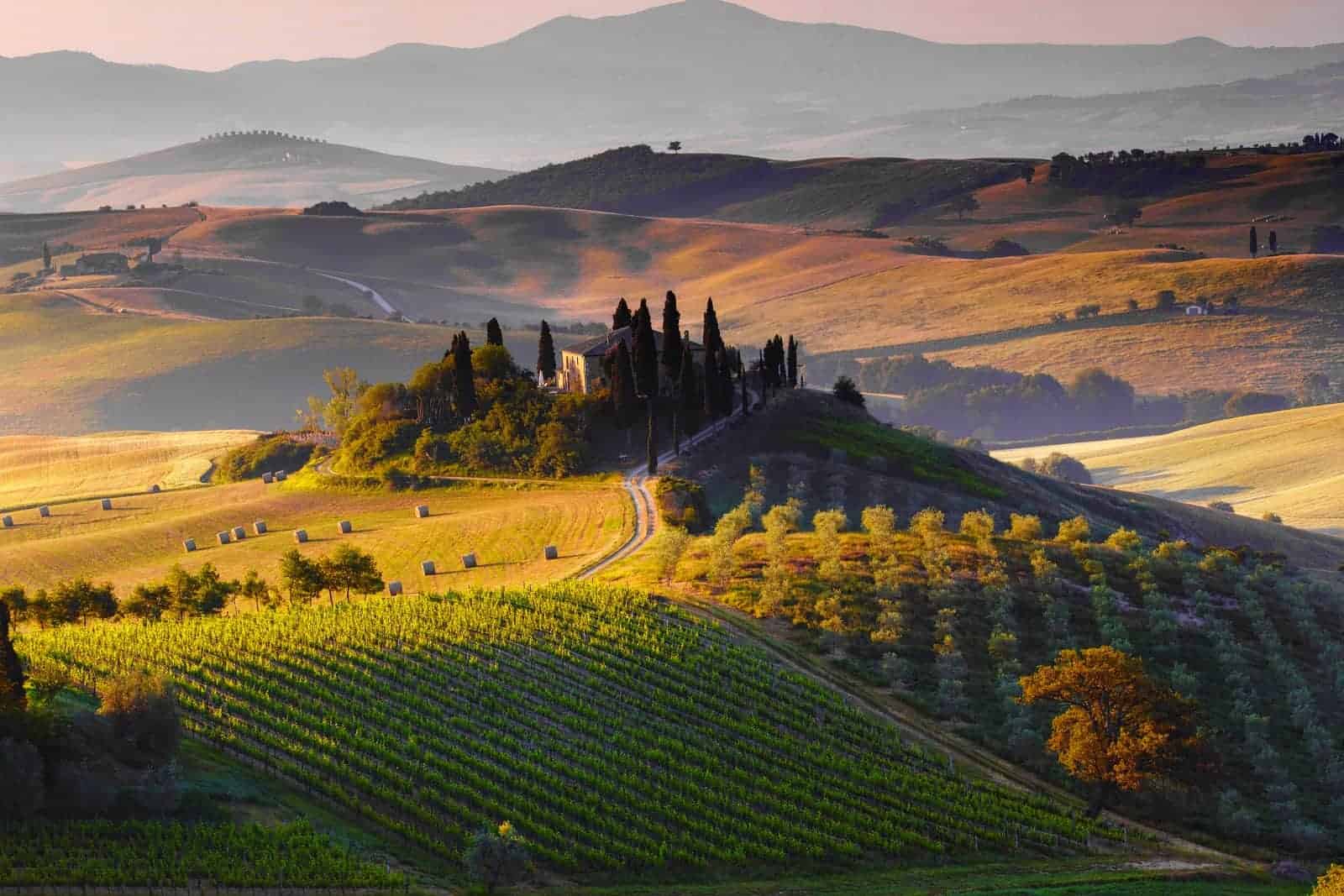
Chianti in the heart of Tuscany
Content
Chianti is the hilly landscape between Florence in the north and Siena in the south – vineyards, olive groves, cypress avenues, castles, and small villages perched on hilltops. This is where Chianti Classico, with its distinctive black rooster, is produced. On this page, you'll find an overview: exactly where Chianti is located, how best to explore it, which places are worth visiting, and how to book a wine tasting.
Chianti – at a glance
- Location: Hilly region between Florence and Siena, provinces of Florence and Siena
- Core communities: Greve, Radda, Gaiole and Castellina in Chianti (entirely within the Chianti Classico area)
- Highest mountain: Monte San Michele, 892 m (near Greve)
- Most beautiful route: the Via Chiantigiana (SR 222) from Florence via Greve and Castellina to Siena
- Best travel time: May/June and September/October (grape harvest)
- Wine tastings: directly from wineries or as Guided Chianti tour at GetYourGuide
Where is Chianti located?
Chianti has no administrative boundary. The term usually refers to the Chianti Classico region: approximately 71.800 hectares between Florence and Siena. This includes the municipalities of Greve, Radda, Gaiole, and Castellina in Chianti in their entirety, and parts of Barberino Tavarnelle, San Casciano in Val di Pesa, Castelnuovo Berardenga, and Poggibonsi. To the east, the Monti del Chianti form the border with the Arno Valley (Valdarno); their highest peak is Monte San Michele at 892 meters, now a nature reserve offering sweeping views across three valleys.
Wine labelled "Chianti" (without Classico) is produced in a much larger area, extending into the provinces of Arezzo, Pisa, Pistoia , and Prato. We explain the differences under Chianti, Chianti Classico, and the DOC/DOCG regulations.
Explore Chianti
Arrival and routes
The classic route is the Via Chiantigiana (SR 222), which leads from Florence via Greve in Chianti, Panzano, and Castellina to Siena. Faster, but lacking in scenery, is the Florence-Siena expressway (RA 3), from which exits lead to places like San Casciano and Tavarnelle. The roads in Chianti are winding and often narrow – allow more time than your GPS suggests, and if you're traveling by campervan, stick to the main roads. If you don't have your own car, the most convenient way to reach Chianti is with a guided tour from Florence or Siena.
Best time to travel
Chianti is at its most beautiful in late spring when everything is green, and in September/October during the grape harvest. It's hot in the height of summer, but the evenings on the hills are pleasant. Find out more under Best Time to Visit Tuscany.
Wine tastings and tours
Many wineries offer guided tours of their cellars and vineyards with tastings; you should usually book in advance. If you don't want to drive yourself (think blood alcohol limit), you can book an organized tour: GetYourGuide, for example, offers a Chianti wine and food tour from Florence with two wineries, or a tour from Siena to Chianti and San Gimignano . You can find more offers in the overview of Chianti tours . For general information about the region's wine, see Tuscany Wine.
Accommodation in Chianti
Typical accommodations include agriturismos on vineyards and holiday apartments in old farmhouses. Greve in Chianti is centrally located on the Via Chiantigiana and is a good base for excursions to Florence and Siena – accommodations in Greve in Chianti can be found at Booking.com.
Find accommodation in Chianti
Places worth seeing in Chianti
Detailed profiles and tips can be found in our article about the most beautiful places in Chianti . Here's a brief overview of the most important ones:
Greve in Chianti and Montefioralle
Greve is considered the main town of Chianti. Its center is Piazza Matteotti, a long, almost triangular square with arcades, wine shops, and butchers. There's a market on Saturdays . Just a few minutes uphill lies Montefioralle, a walled medieval village with cobbled streets.
Radda in Chianti and Volpaia
Radda was the main town of the Lega del Chianti in the Middle Ages; in the town center stands the Palazzo del Podestà with its coat of arms on the facade. A few kilometers to the north lies Volpaia, a small fortified village built around a medieval fortress, which today is largely dominated by a winery.
Gaiole in Chianti and Brolio Castle
Gaiole is surrounded by castles and vineyards. To the south lies Castello di Brolio, the ancestral seat of the Ricasoli family. Cyclists know Gaiole from L'Eroica, a race on gravel roads with vintage racing bikes.
Castellina in Chianti
Castellina lies on a ridge between the valleys of Pesa, Elsa, and Arbia. On the outskirts of the town is the Etruscan burial mound of Montecalvario; finds are displayed in the Archaeological Museum of Chianti Senese, located within the town itself.
Impruneta
Impruneta südlich von Florenz ist bekannt für seine Terrakotta-Werkstätten. Die Basilika Santa Maria all’Impruneta geht auf das 11. Jahrhundert zurück. Im Herbst feiert der Ort sein traditionelles Traubenfest.
On the edge of Chianti: Monteriggioni and Montespertoli
Monteriggioni, north of Siena, is no longer part of the Chianti Classico region, but it's a worthwhile detour: Dante mentions its completely preserved ring wall with its towers in the Divine Comedy. Montespertoli, west of the Classico region, celebrates the Mostra del Chianti, a multi-day wine festival, every year at the end of May/beginning of June.
History of Chianti
Im 13. Jahrhundert schlossen sich Castellina, Radda und Gaiole zur Lega del Chianti zusammen, einem Militärbund im Dienst von Florenz gegen Siena. Ihr Wappen, ein schwarzer Hahn auf goldenem Grund, ist heute das Zeichen des Chianti Classico. 1716 legte Großherzog Cosimo III. de’ Medici per Erlass die Grenzen des Weinbaugebiets fest – eine frühe Vorform heutiger Herkunftsbezeichnungen. 1924 gründeten 33 Winzer das Konsortium des Chianti Classico.
Im 19. Jahrhundert entwickelte Baron Bettino Ricasoli auf Schloss Brolio die Rebsortenmischung, auf der der Chianti lange beruhte, mit Sangiovese als Hauptsorte. Ricasoli, später italienischer Ministerpräsident, hieß wegen seiner Strenge der „eiserne Baron“. Um ihn ranken sich Legenden: Nach seinem Tod soll er als Geist zu Pferd rund um Brolio unterwegs sein. Heute muss ein Chianti Classico zu mindestens 80 Prozent aus Sangiovese bestehen.
Frequently asked questions about Chianti
Where exactly is Chianti located?
Between Florence in the north and Siena in the south. The core area comprises the municipalities of Greve, Radda, Gaiole and Castellina in Chianti; in addition, parts of San Casciano, Barberino Tavarnelle, Castelnuovo Berardenga and Poggibonsi.
What are the most beautiful places in Chianti?
Popular destinations include Greve in Chianti with its market square, the hilltop village of Montefioralle, Radda, Volpaia, Castellina, and Gaiole with the Castello di Brolio. Monteriggioni, on the outskirts of Chianti, is also worth a visit.
What is the difference between Chianti and Chianti Classico?
Chianti Classico comes from the historical heartland between Florence and Siena and bears the black rooster. Chianti without any designation comes from a significantly larger area of Tuscany and has its own regulations.
When is the best time to travel to Chianti?
May, June, September, and October. Autumn is grape harvest time, and the landscape is particularly green in spring. July and August are often very hot.
Is it possible to visit Chianti without a car?
Limited. While buses do run from Florence and Siena to the larger towns, guided wine tours from Florence or Siena, which combine several wineries, are more convenient.
What is the highest mountain in Chianti?
Monte San Michele near Greve in Chianti is the highest peak of the Monti del Chianti at 892 meters.


