



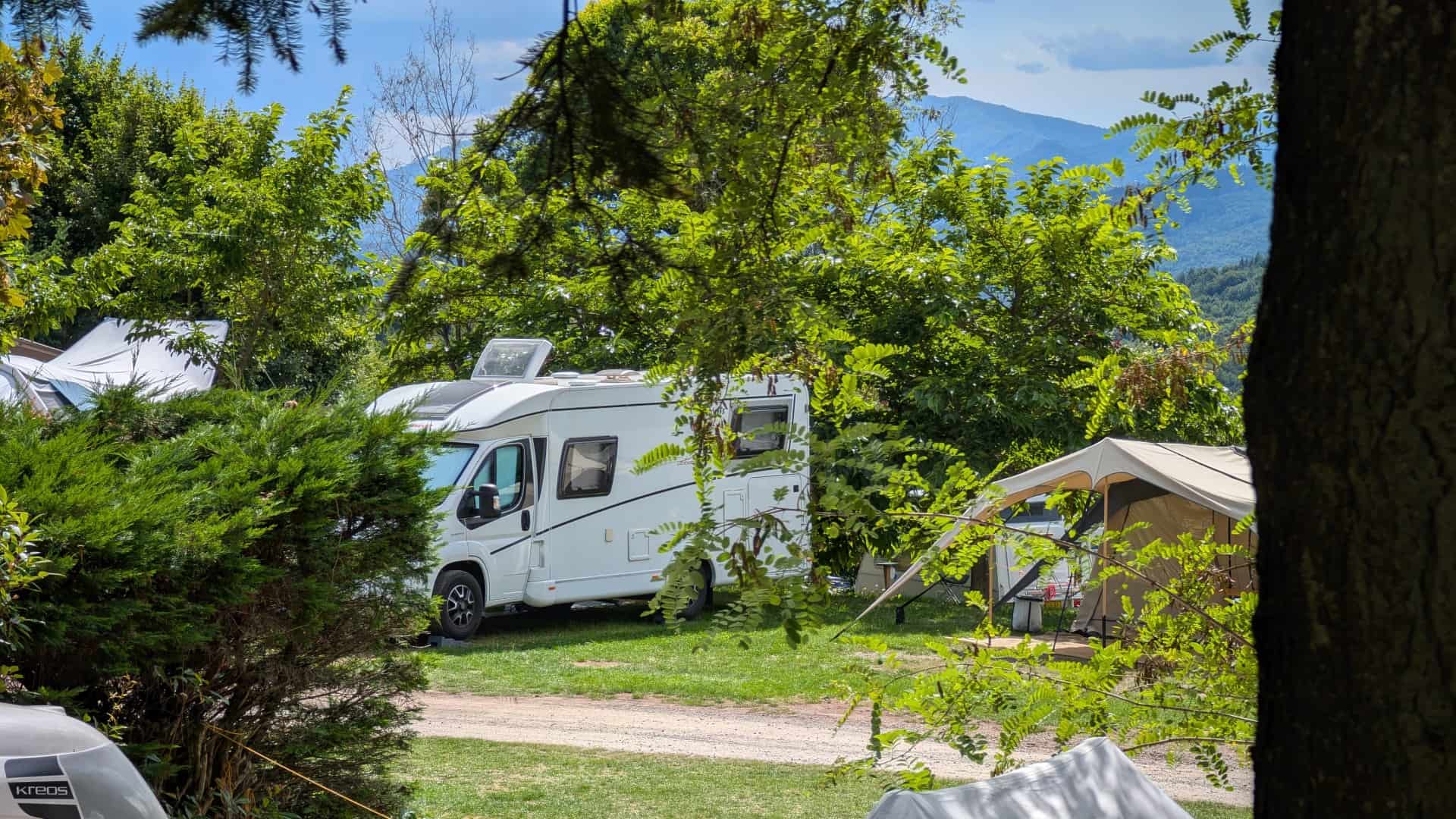
Camping etiquette for Tuscany: Rules, behavior and pitfalls on an Italian holiday
Content
Campsites in Tuscany are generally relaxed – but there are still rules and customs that might surprise German campers: midday quiet hours with closed barriers, swimming caps in the pool, strict waste separation, and the subtle difference between parking and camping on designated pitches. This camping etiquette guide shows you what to keep in mind.
The most important rules in brief
- Lunch break: Usually around 13 p.m. to 15 p.m. – the barrier remains closed at many sites.
- Pool: Swimming caps are mandatory almost everywhere, even for children.
- Registration: Please present your ID at reception – campsites are required to report all guests to the police.
- Garbage: Separate consistently (organic materials, plastic/metal, glass, paper, rest).
- plots: Parking yes, camping no – no awnings, chairs or leveling jacks in basic parking areas.
- Feuer: ab 1. Juli gilt in der Toskana ein Feuerverbot im Freien; Holzkohle ist auf vielen Plätzen ganzjährig verboten.
Rest periods: Take the midday rest seriously
Tuscan campsites have a midday rest period, usually between 13 pm and 15 pm , and at some sites until 16 pm. Quiet hours also apply at night – the exact times are listed in the campsite rules at reception.
- Driving ban on the premises: In many parking areas, the barrier remains closed during the midday rest period. Those arriving during this time wait at the entrance; those needing to catch a ferry park their vehicles outside the entrance beforehand.
- Be quiet: Music, hammering during assembly, and slamming sliding doors on the van are forbidden.
Use your time like the locals: in the shade under the awning, perhaps with one of our books about Tuscany.




Swimming cap in the pool: Why the lifeguard is whistling
In almost all Italian swimming pools – including those at campsites – the pool rules require a swimming cap ( cuffia ) for both adults and children. Arguing with the lifeguard ( bagnino ) is pointless.
- Our advice: Pack a simple fabric or silicone cap for each family member. Anyone who forgets one can usually buy one in the campsite shop or at reception. You don't need a cap in the sea – if you're on one of the Campsites right by the sea It stands, so it can do without it.
Check in at reception: Have your ID ready
Campsites, like hotels, are legally required to report the data of all guests to the police – usually within 24 hours of arrival via the Alloggiati Web portal . Therefore, have a national identity card or passport ready for all travelers. Some receptions may briefly retain the ID to record the data.
Raccolta differenziata: Waste separation in Italian
Waste separation ( raccolta differenziata ) is consistently implemented in Tuscany, including at campsites. The color of each bin is determined by the respective municipality – pay attention to the labels. For guidance:
| Color of the barrel | Italian term | What goes inside? |
| mostly brown (marrone) | Organico / Umido | Leftover food, coffee grounds, organic waste (often only in biodegradable bags!). |
| often yellow, blue or white | Plastica / Metallo | Plastic bottles, yogurt cups, aluminum foil, tin cans (often disposed of together). |
| mostly green (Verde) | Glass | Clean glass (bottles, jars). Make sure not to include any plastic lids or caps. |
| Grey black | Indifferenziato / Secco | Pure residual waste that cannot be recycled at all. |
Residual waste is often only accepted at specific times or at a central collection point. Ask where the waste collection point is upon arrival.
Sosta or camping: What is allowed on campsites
In Tuscany, at motorhome pitches ( aree di sosta ) and parking lots, a distinction is made between sosta (parking) and campeggio (camping). According to Article 185 of the Italian Highway Code, your motorhome is considered parked as long as it is resting on its wheels, nothing is extended, and no fluids are leaking.
Prohibited on standard parking spaces:
- Extend the awning or stretch the sunshade
- Set up chairs, a table, or a clothesline
- Extending support jacks or opening awning windows that protrude beyond the vehicle dimensions
Violations of municipal regulations usually cost between €25 and €500, while emptying wastewater costs around €84 to €335. Private campsites often permit camping – the site rules are the determining factor. You can find more information in our guide to wild camping in Italy and in our overview of the Italian traffic regulations.
Barbecues and fires: Be aware of the forest fire risk
In der Toskana gilt jedes Jahr ab dem 1. Juli (in der Regel bis 31. August) ein Verbot, im Freien Feuer zu entzünden; Grillen ist dann nur noch an dafür ausgestatteten Stellen erlaubt. Viele Plätze in Pinienwäldern verbieten Holzkohle ohnehin. Gas- und Elektrogrills werden meist geduldet – frag an der Rezeption. Wenn dir unterwegs das Gas ausgeht: Campinggas in Italien.
Reserve a spot: Stress-free through the high season
Popular campsites on the coast are often fully booked in July and August. Searching spontaneously with children in the back seat or a dog in 35-degree heat is no fun – book in advance during peak season. Tips on online portals and direct booking can be found in our guide to finding and booking campsites.
Our insider tip for holiday planning: Use our partner Camping.info 's portal to prepare your itinerary stress-free. Here you'll find a comprehensive overview of Italy's most beautiful campsites. When searching, specifically use the filter for sites that can be booked directly online.


Market, café and supermarket: Small customs
At the weekly market, it's best to have the vendor pack your fruit and vegetables rather than picking them yourself; disposable gloves are available at the fruit counter in supermarkets. For larger purchases, our guide to shopping in Tuscany will be helpful.
In cafes, Italians usually only drink cappuccino at breakfast; after a meal, they order an espresso ( un caffè ). A friendly "Buongiorno" or "Buonasera" at reception and to your neighbor will open many doors. In the evening, a glass of Tuscan wine in front of your camper is a nice touch.
You can find all camping guides in our overview of camping holidays in Tuscany.
Frequently asked questions about camping etiquette in Tuscany
Why do I have to hand in my ID at reception?
Campsites are required to report the details of all guests to the police, usually within 24 hours via the Alloggiati Web portal. Some receptions briefly retain identification for this purpose.
When is the midday rest period at Italian campsites?
Usually from about 13 p.m. to 15 p.m., at some sites until 16 p.m. At many sites, the barrier remains closed during this time, and entry and exit are not possible.
Is a swimming cap really mandatory in the pool?
Yes, almost all swimming pools in Italy require a swimming cap in their bathing regulations – even at campsites and even for children. You don't need one in the sea.
Am I allowed to hang laundry on a campsite?
Not allowed on simple municipal parking spaces, as a clothesline outside the vehicle is considered camping. It is permitted on campsites and many private parking areas – the site rules will determine the specifics.
Is barbecuing allowed at campsites in Tuscany?
Gas- und Elektrogrills sind meist erlaubt. Holzkohle ist in Pinienwäldern oft verboten, und ab dem 1. Juli gilt in der Toskana ein Feuerverbot im Freien, das Grillen nur an ausgestatteten Stellen zulässt.


