Travel to Tuscany with your dog
Content
Traveling to Tuscany with your dog is straightforward, provided the paperwork is in order: Within the EU, your dog needs a microchip , the blue EU pet passport , and a valid rabies vaccination . In Italy itself, leash and muzzle rules apply, and during the season, dogs are usually only allowed on designated dog beaches. Here you will find everything you need to know about your arrival, stay, and excursions.
Short answer: What does my dog need for Italy?
- Microchip (ISO standard) – implanted before rabies vaccination
- EU pet passport with registered, valid rabies vaccination
- First vaccination no earlier than 12 weeks, then wait at least 21 days before traveling.
- In Italy: Leash max. 1,5 m in towns and public places, muzzle always with you, carry poop bags
- On the beach: during the bathing season only on designated dog beaches (beach for dogs, dog beach)
Traveling to Italy with a dog
Microchip, pet passport and rabies vaccination
For travel within the EU, uniform rules apply: Your dog must be microchipped (older, clearly legible tattoos from before July 3, 2011, are also accepted) and have an EU pet passport showing a valid rabies vaccination. The first rabies vaccination can be given no earlier than 12 weeks of age; at least 21 days must pass before the vaccination is considered valid and you are allowed to travel. Booster shots given within the validity period are valid immediately. Up to five pets are allowed to travel per person. You can obtain the microchip, passport, and vaccination from your veterinarian – please allow sufficient waiting time for puppies.
Transit through Austria and Switzerland
Austria is an EU member, so the same entry rules apply. Switzerland also accepts the EU pet passport. However, while traveling, the rules of the respective country apply – in Austria, for example, leash or muzzle requirements in public places vary depending on the federal state. Therefore, take a leash and muzzle readily available and keep your dog on a leash at rest stops. Information on vignettes and tolls along the route can be found under Tolls to Italy 2026.
On the way in the car
The drive to Tuscany can get very hot. Make sure you have plenty of fresh water, plan regular breaks, and never leave your dog in a parked car. A dog blanket is handy for restaurant visits, so your pet can lie down on it.
Rules for dogs in Italy
Leash, muzzle and poop bags
In Italy, dogs must be kept on a leash no longer than 1,5 meters in towns and other public places . You must always carry a muzzle with you to put on your dog if necessary or upon request from the authorities. It is also mandatory to pick up after your dog – so always carry bags with you. Municipalities may impose stricter rules, for example, for parks or historic city centers.
Dogs on buses and trains
In öffentlichen Verkehrsmitteln gelten eigene Regeln. Bei Trenitalia reisen kleine Hunde in einer Transportbox (max. 70 × 30 × 50 cm, eine Box pro Person) in der 1. und 2. Klasse kostenlos mit. Größere Hunde brauchen ein eigenes Ticket – in Frecce und Intercity 5 € (samstags 1 €), im Regionalverkehr 50 % des Fahrpreises der 2. Klasse – und müssen an der Leine und mit Maulkorb mitfahren (laut Trenitalia, Stand November 2026). Ausnahmen für einzelne Züge nennt Trenitalia auf seiner Website und im offiziellen Fahrplan; prüfen Sie die aktuellen Bedingungen vor der Fahrt beim jeweiligen Verkehrsunternehmen.
Accommodation and camping with dogs
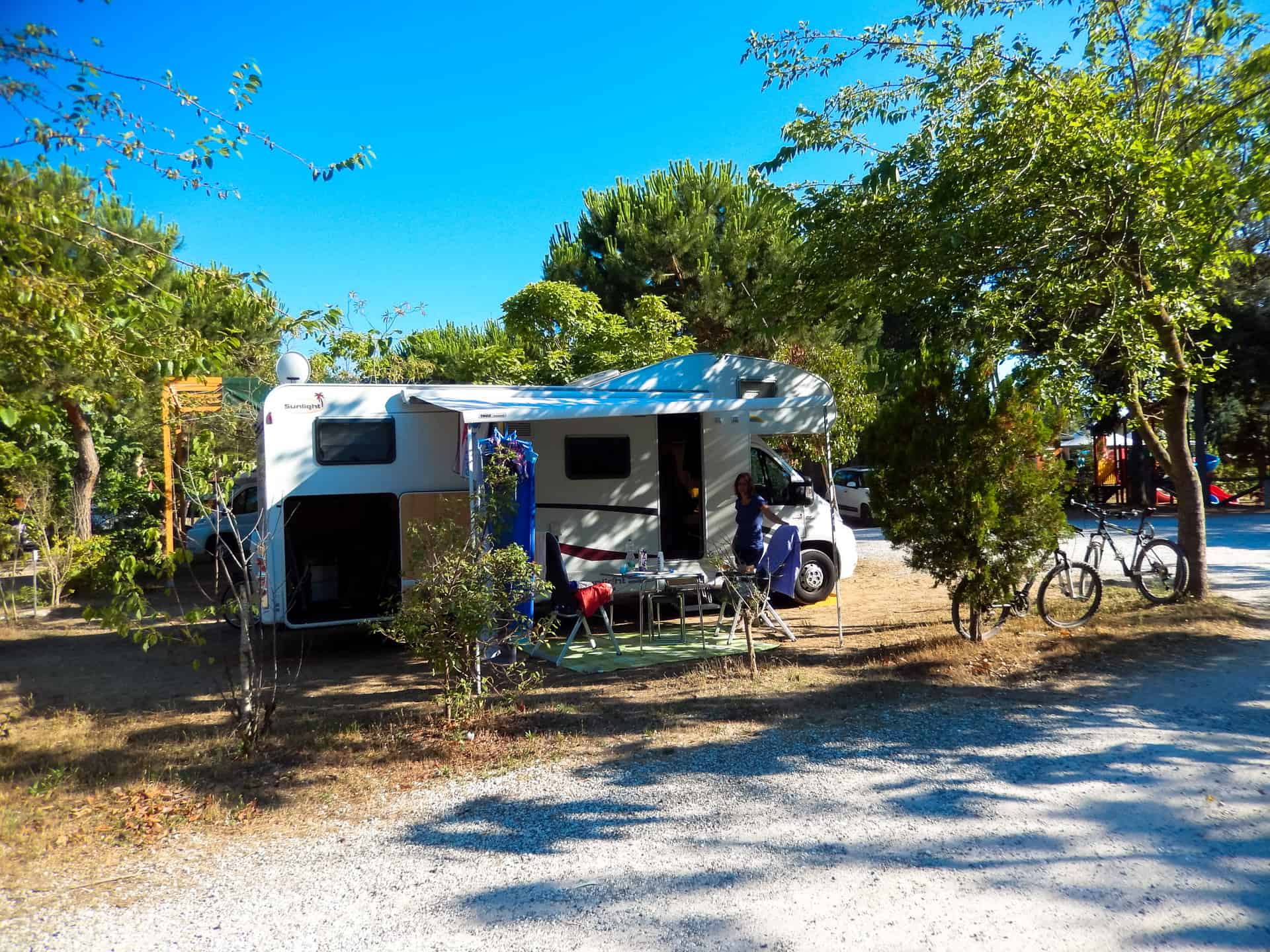
Dogs aren't welcome everywhere – ask before booking whether dogs are allowed and what the extra charge might be. You can find dog-friendly accommodations on our page " Holiday homes with dogs in Tuscany" . Those traveling with a campervan or tent will find tips under " Camping with dogs in Tuscany".
Dog beaches in Tuscany
During the bathing season (roughly May to September, depending on the municipality), dogs are prohibited on most beaches. They are permitted on designated dog beaches, which are often part of a public beach area or established by the municipality. The exact rules are posted on signs at the beach. Outside of the season, the rules are often more relaxed – but even then, be sure to check local regulations. You can find an overview of the coast on our page about the beaches of Tuscany.
Our tip: Fuorirotta Beach near Marina di Grosseto
A particularly recommended beach is located in the Maremma region in Marina di Grosseto, in the La Canova district (municipality of Grosseto), on the coastal road towards Castiglione della Pescaia : At Fuorirotta Beach, more than half of the beach area is reserved for dogs and their owners, and leashed dogs are also welcome at the beach bar. During our visit, the dog area was bustling with all sorts of dog breeds; locals also like to come here for early morning or late evening walks. The shaded parking area is about a 15-minute walk away, the path leading through a pine forest. There is a separate freshwater shower and water bowls for dogs. Right next to it, the municipality of Grosseto has also established a public dog beach (Dog Beach Nord).
Best time to travel and excursions with a dog
When is the best time to take a dog to Tuscany?
The best time to travel with a dog is from March to June and in September/October: It's not too hot then and the beaches are less crowded. During the summer holidays, the beaches are often packed, and the midday heat can be stressful for many dogs. An inflatable paddling pool at your accommodation will provide a refreshing break.
Lucca: ideal for dog owners
Lucca, in northern Tuscany, is a perfect city for dog lovers thanks to its many green spaces . You can enjoy wonderful walks or bike rides along the approximately 4,2 km long, tree-lined city walls, gazing into the narrow streets of the old town. At the foot of the walls are wide lawns ideal for running and playing fetch. You'll find dispensers for dog waste bags at regular intervals along the walls, and Lucca also boasts plenty of drinking fountains.
bars and restaurants
Dogs are a common sight in Lucca, as in many places in Tuscany. Well-behaved dogs are welcome in most bars and restaurants, especially on terraces, and a bowl of water is often brought without being asked. If in doubt, just ask before going in.
Frequently asked questions about traveling with a dog to Tuscany
What documents does my dog need for Italy?
A microchip, an EU pet passport, and a valid rabies vaccination certificate recorded therein are required. After the initial vaccination (at the earliest at 12 weeks of age), you must wait at least 21 days before traveling.
Does my dog have to wear a muzzle in Italy?
Not permanently, but you must always carry a muzzle with you and put it on when necessary or at the request of the authorities. It is mandatory for larger dogs on public transport such as trains.
How long can the leash be in Italy?
In towns and public places, the maximum distance is 1,5 meters. Retractable leashes should be locked at a correspondingly short length in these areas.
Are dogs allowed on the beach in Tuscany?
During the bathing season, dogs are usually only allowed on designated dog beaches, such as Fuorirotta Beach or Dog Beach Nord near Marina di Grosseto. The rules are set by each municipality and are posted on signs at the beach.
Is my dog allowed in restaurants?
Well-behaved dogs are welcome in many bars and restaurants in Tuscany, especially on terraces. However, there is no obligation to allow them – it's best to ask.
When is the best time to travel with a dog?
Spring (March to June) and early autumn (September/October). In the height of summer, heat and crowded beaches are stressful for many dogs.