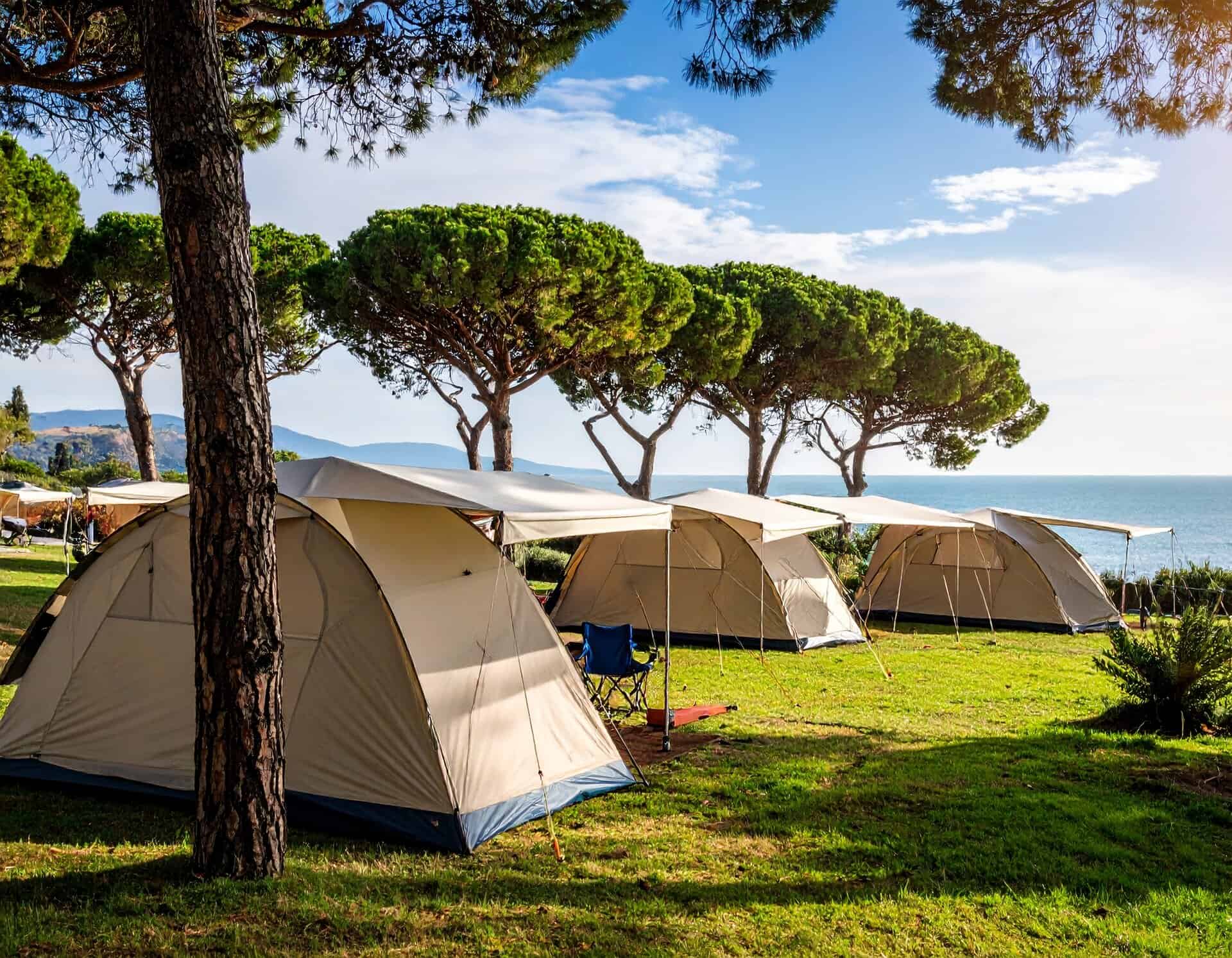
With the caravan through Tuscany
Content
Traveling through Tuscany with a caravan combines a beach holiday with a cultural trip: you stay at a campsite by the sea or in the hinterland and explore cities like Pisa, Florence, or Siena from there. A few Italian rules for caravans are important, as is proper route planning to avoid narrow mountain villages and a suitable campsite as a base.
The most important things for sidecar drivers
- Speed limits for caravans: 50 km/h in built-up areas, 70 km/h outside built-up areas and on expressways, 80 km/h on motorways.
- tollA car with a single-axle caravan travels in class 3, with a tandem-axle caravan in class 4.
- Overnight stays: practically only at campsites – motorhome pitches are usually not intended for caravans.
- Bicycle carrier on the drawbar or at the rear: red and white warning sign 50 × 50 cm if it protrudes
- Avoid old towns and gravel roads (strade bianche) when driving a horse-drawn carriage.
On the road with the horse-drawn carriage
Traffic rules and tolls
According to the ADAC (German Automobile Club), the speed limits for cars towing caravans in Italy are 50 km/h in built-up areas, 70 km/h on rural roads and expressways, and 80 km/h on motorways. Outside built-up areas and on motorways, headlights are mandatory even during the day. Motorway tolls depend on the number of axles: a car with a single-axle caravan is classified as class 3, and a car with a two-axle caravan as class 4 – this is significantly more expensive than driving a car alone. Information on vignettes for Austria and Switzerland, as well as the Brenner Pass toll, can be found under "Tolls to Italy 2026" ; all other regulations are outlined in the Italian Highway Code.
Plan routes
The coastal road Via Aurelia (SS1) and highways like the Firenze–Pisa–Livorno route are easily navigable with a caravan. Things get tricky in the historic hilltop towns: Tuscany's roads are often narrow and steep, and the town centers are usually ZTL zones with restricted traffic. The picturesque gravel roads (strade bianche) leading to wineries and agriturismos are also often unsuitable for caravans. Therefore, park your caravan at the campsite and use your towing vehicle alone for excursions.
Gas and supply
German gas cylinders are neither exchanged nor refilled in Italy. Bring enough gas with you or switch to a refillable cylinder or Italian cylinders with an adapter – details can be found under Camping Gas in Italy and Gas in Motorhomes . You can read about the safety of the tap water under Drinking Water Quality in Italy.
Discover Tuscany individually
A caravan offers you a great deal of freedom: you're not bound by bus schedules and can visit the region's historic cities from your campsite. Tuscany's UNESCO World Heritage sites include the old towns of Florence, Siena, San Gimignano, and Pienza, Pisa's Piazza del Duomo with its Leaning Tower , and the Val d'Orcia. Lucca, with its walkable city walls, and Arezzo are also well worth a visit . And then there are the beaches of Tuscany and the island of Elba , which you can reach by ferry from Piombino – even with a caravan.
Campsites for caravans
Especially along the coast, there is a wide selection of campsites with pitches for caravans. Many are only open from spring to autumn; you should book in advance during peak season. Further suggestions can be found under Campsites directly by the sea , Camping near Pisa , and Camping holidays in Tuscany.
Camping Torre Pendente in Pisa
Das Camping Village Torre Pendente liegt nur rund zehn Gehminuten vom Schiefen Turm entfernt und etwa 300 m vom Bahnhof Pisa San Rossore – ideal für Stadtbesichtigungen und Bahnausflüge nach Lucca oder Florenz. Es gibt schattige Stellplätze für Zelte und Wohnwagen, Mobilheime, Pool, Restaurant, Minimarkt und kostenlose Duschen. Die Saison 2026 läuft laut Betreiber vom 1. April bis 1. November.
Camping Mare e Sole in Calambrone
Located directly on the sandy beach between Marina di Pisa and Livorno in Calambrone is the Mare e Sole campsite . It offers numerous pitches for caravans and motorhomes, private beach access, a swimming pool with a children's pool, a mini-market, a restaurant and bar, as well as a playground and entertainment program. Dogs are only allowed in designated areas. Current opening times can be found on the campsite's website.
Frequently asked questions about caravan holidays in Tuscany
How fast am I allowed to drive with a caravan in Italy?
50 km/h in built-up areas, 70 km/h on rural roads and expressways, and 80 km/h on motorways.
Which toll class applies to a vehicle combination in Italy?
A car towing a single-axle caravan is classified as class 3, while a car towing a two-axle caravan is classified as class 4. The toll is therefore significantly higher than for the car alone.
Am I allowed to park my caravan freely in Tuscany?
Stay overnight with your caravan at campsites. Wild camping is prohibited in many municipalities, and motorhome pitches are usually not designed for caravans.
Can I take my caravan to Elba?
Yes, the ferries from Piombino also accept vehicles with trailers. The crossing to Portoferraio takes about an hour; book early during peak season and specify the correct total length of your vehicle.