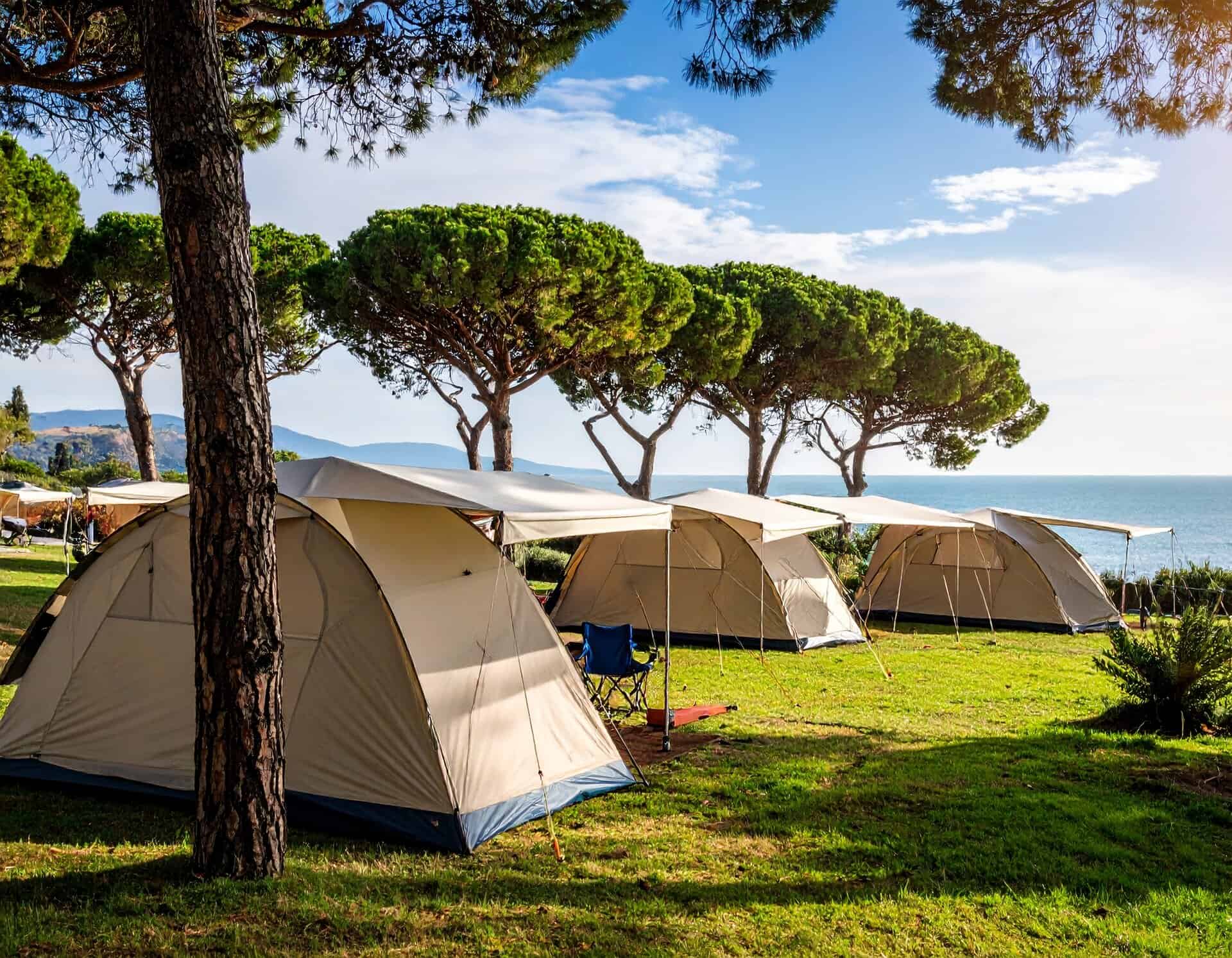
With the camper in Tuscany
Content
Traveling to Tuscany in a motorhome means combining sea, hills, and cities in one holiday. To ensure a relaxed journey, you should be aware of some Italian peculiarities – from speed limits and warning signs to tolls, parking, overnight stays, and gas supply. Here you will find the most important information in a concise format (as of 2026).
At a glance
- Speed limits: Motorhomes up to 3,5 t are subject to the same speed limits as passenger cars (130/110/90/50 km/h), over 3,5 t max. 100 km/h on motorways and 80 km/h outside built-up areas.
- Lights: Outside of towns and on motorways, dipped headlights or daytime running lights are required even during the day.
- Rear bicycle carrier: red and white warning panel 50 × 50 cm mandatory
- Tolls: distance-dependent, most motorhomes pay class B; no vignette required in Italy
- Old towns: Do not enter ZTL zones (Zona a traffico limitato) – cameras, high fines
- German gas cylinders are neither exchanged nor refilled in Italy.
Traffic regulations for motorhomes in Italy
Speed limits
| vehicle. | in town | outside of town | Expressway | Highway |
|---|---|---|---|---|
| Motorhome up to 3,5 t | 50 | 90 | 110 | 130 |
| Motorhome over 3,5 t | 50 | 80 | 80 | 100 |
| Car with caravan | 50 | 70 | 70 | 80 |
Many Italians drive fast – don't let them influence you. Fines in Italy are significantly higher than in Germany, and speed cameras (Autovelox) and section control systems (Tutor) are widespread. Outside of built-up areas and on motorways, you must drive with dipped headlights or daytime running lights, even during the day. The blood alcohol limit is 0,5 (0,0 for novice drivers in their first three years). You need a high-visibility vest if you have to get out of your car outside of built-up areas. You can find all the rules in our article on the Italian traffic regulations.
Warning sign for bicycle carriers
If cargo extends beyond the rear of the vehicle – including a bicycle carrier attached to the rear or towbar – it must be marked in Italy with a red and white striped, reflective warning panel measuring at least 50 x 50 cm. According to the ADAC (German Automobile Club), this also applies to carriers with their own lights and license plates. Violations are subject to fines starting at around €87, and the driver may be prohibited from continuing their journey.
Narrow streets and ZTL zones
The streets in Tuscany's old towns are often narrow, steep, and unsuitable for large vehicles. Many historic centers are also ZTL zones (Zona a traffico limitato), which can only be entered with a permit and are monitored by cameras – the fine will arrive in the mail months later. Check the map beforehand to see if you can drive your campervan into town. It's usually better to stay outside in a parking lot or designated area and enter on foot, by bicycle, or by bus.

Parking and overnight stays
Parking space markings
- White lines: Free parking (observe signs for time or vehicle restrictions)
- Blue lines: Parking is subject to a fee – purchase your parking ticket from the machine or via app.
- Yellow lines: reserved, e.g. for residents, taxis, buses or people with disabilities
- Yellow and black marked curb: no-parking zone
Parking violations are strictly enforced in Italy – usually with fines ranging from €42 to €173, and exceeding the parking time limit with fines ranging from €26 to €102 (as of 2026); those who pay within five days receive a 30% discount on many fines. When parking, also pay attention to height restrictions and signs prohibiting motorhomes.
Pitches, campsites and free camping
In Tuscany, there are numerous motorhome pitches ( area di sosta camper ), often with water and waste disposal facilities. A selection can be found under Motorhome Pitches in Tuscany , and campsites by the water under Campsites by the Sea . For a quieter experience, consider agricampeggio on a farm . In Italy, motorhomes are generally allowed to park wherever cars are permitted – however, camping equipment (awnings, chairs, leveling blocks, supports) is not allowed, and many coastal municipalities prohibit overnight stays outside of designated pitches and campsites. Details can be found under Wild Camping in Italy.
Tolls, gas and water
Tolls on Italian motorways
There is no vignette in Italy; motorway tolls are calculated based on kilometers driven and vehicle class. The number of axles and the height at the front axle are crucial: two-axle vehicles up to 1,30 m in height at the front axle pay class A, higher vehicles – which includes most motorhomes – pay class B. You pay at the toll booth in cash (lanes with a white sign) or by card (blue sign "Carte"). With a transponder such as Telepass or Bip&Go, you can drive through the yellow-marked "T" lanes without stopping. According to the provider, Bip&Go costs €2,10 per month of use plus €2,50 for each month you drive in Italy; there are also one-time setup and shipping fees (as of 2026). Check whether the provider covers your vehicle class. All prices for vignettes in Austria and Switzerland, as well as tunnel and Brenner Pass tolls, can be found under Tolls to Italy 2026.
Gas cylinders and drinking water
German gas cylinders are neither exchanged nor refilled at LPG filling stations in Italy. Italian cylinders with adapters, permanently installed cylinders, or refillable cylinders with an 80% fill stop are possible and can be refilled at LPG filling stations. You can read more about this under Camping Gas in Italy and Gas in Motorhomes . Whether you can drink tap water or fill your fresh water tank is explained in the article on drinking water quality in Italy.
At the campsite
Many Italian campsites require swimmers to wear a swimming cap in the pool . This isn't a law, but a campsite rule – if you don't have a cap, you can usually buy one at reception for a small fee.
Many receptions have a fixed midday break during which arrivals are not possible; often the barrier is also closed at this time. Upon arrival, please inquire about the campsite rules, such as midday and nighttime quiet hours, and the times you are permitted to enter and exit.
All camping-related topics – from campsites by the sea to pitches and rules – can be found in our guide Camping Holidays in Tuscany.
Frequently asked questions about motorhome holidays in Tuscany
How fast am I allowed to drive a motorhome in Italy?
For vehicles up to 3,5 tons, the same speed limits apply as for passenger cars: 50 km/h in built-up areas, 90 km/h outside built-up areas, 110 km/h on expressways, and 130 km/h on motorways. Heavier motorhomes are permitted to travel at 80 km/h outside built-up areas and on expressways, and at 100 km/h on motorways.
Do I need a warning sign for the bicycle carrier in Italy?
Yes. If the bicycle carrier extends beyond the rear of the vehicle, a red and white reflective warning sign measuring at least 50 x 50 cm is mandatory. Violations are subject to fines.
What toll class does a motorhome fall into in Italy?
This depends on the number of axles and the height at the front axle. Two-axle vehicles with a front axle height exceeding 1,30 m – which is most motorhomes – fall into category B.
Am I allowed to park my motorhome freely in Tuscany?
Parking is permitted where cars are allowed to park, as long as you are not camping (no awnings, chairs, or supports). However, many municipalities prohibit overnight stays outside of designated parking areas and campsites – pay attention to signs.
Can I exchange my German gas cylinder in Italy?
No. German bottles will neither be exchanged nor refilled. Use an Italian bottle with an adapter or a refillable bottle that can be filled at LPG filling stations.
What is a ZTL?
A Zona a traffico limitato is a restricted traffic zone, usually located in historic centers. Entry is prohibited without a permit; cameras record violations and fines are issued retroactively.