


Travel routes to Tuscany through Italy
Content
You can reach Tuscany from Germany by car via two main routes: through Austria and the Brenner Pass, or through Switzerland via the Gotthard and San Bernardino passes. Alternatively, you can take a comfortable night train to Florence or fly to Pisa or Florence. This page shows the routes through Italy – we describe the routes to the border on separate pages.
At a glance
- Via the Brenner Pass: A22 to Modena, then A1 to Florence or towards the coast
- About Switzerland: Milan, A1 to Parma, A15 to La Spezia, A12 along the coast
- toll: Italy does not have a vignette; tolls are charged on motorways depending on the distance traveled; Austria and Switzerland require a vignette.
- Train: ÖBB Nightjet from Munich with a stop in Florence; during the day by EuroCity to Bologna
- Flight: Pisa Airport (Galileo Galilei) and Florence Airport (Amerigo Vespucci)
Driving to Tuscany
Remember that most motorways in Italy are toll roads. You take a ticket when entering the motorway and pay at the exit toll booth in cash, by card, or with Telepass. There is no vignette in Italy. Current prices for Italy, Austria, and Switzerland can be found on our 2026 toll page.
From Austria: Brenner route via Modena
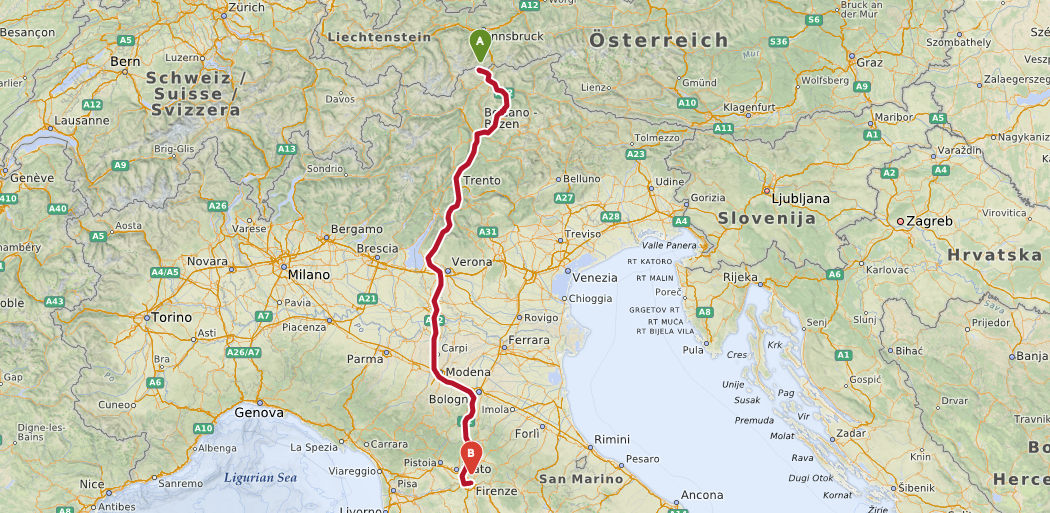
If you are coming from Austria via the Brenner Pass, take the A22 through Bolzano and Verona to Modena, then switch to the A1 . Continue via Bologna to Florence and into the Tuscan countryside. Those heading to the coast can take the toll-free FI-PI-LI expressway towards Pisa and Livorno near Florence . For complete information on the route to the Brenner Pass, the vignette, and exit restrictions in Tyrol, see Travel Routes through Austria.
From Switzerland: via Milan and La Spezia
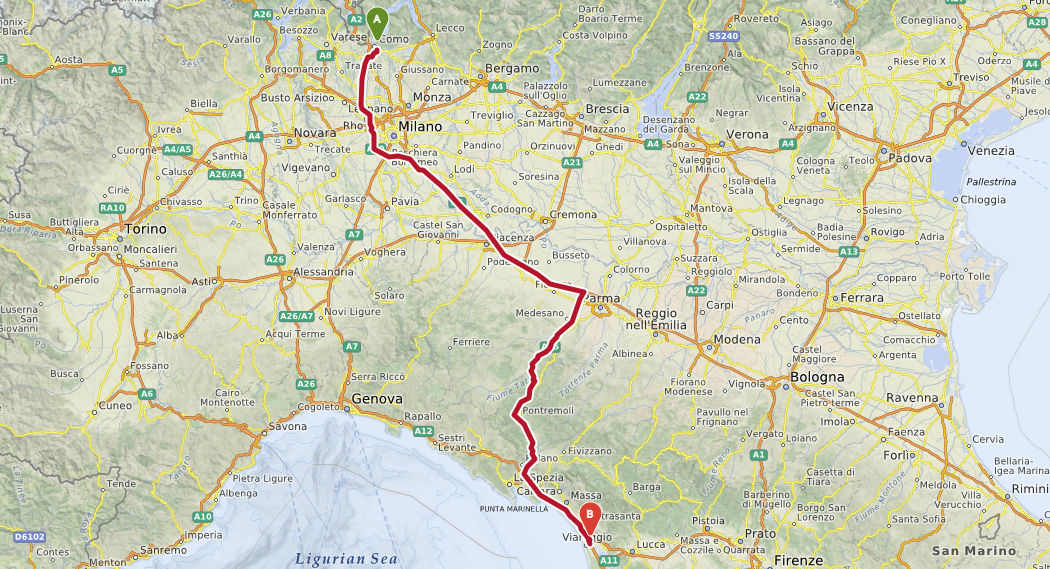
If you are coming from Switzerland, first head towards Milan (Milano) and bypass the city on the "Tangenziale Ovest". Take the A1 towards Parma/Modena. Shortly before Parma, turn onto the A15 towards La Spezia. The A15 leads through the Apennines (very hilly towards the end) and meets the A12 at Santo Stefano di Magra . From there, you are almost in Tuscany. Take the A12 south via Viareggio , Pisa, and Livorno to Cecina. The toll section ends at San Pietro in Palazzi; the four-lane, toll-free SS1 Variant Aurelia continues to Grosseto.
If your destination is Florence or the interior of the country, simply continue on the A1 via Bologna to Florence, instead of turning onto the A15 at Parma. We describe the routes through Switzerland (Gotthard or San Bernardino) and the Swiss vignette under Routes through Switzerland.
Important for drivers in Italy
- Speed limit on motorways 130 km/h (110 km/h in rain), dipped headlights required outside built-up areas even during the day
- High-visibility vest readily accessible inside the vehicle, warning sign for bicycle carrier
- Do not enter historic city centers with ZTL zones without authorization – camera surveillance
All the details can be found in our travel guide for Italy . Tips for local excursions can be found under Discovering Tuscany by Car.
We have summarized the rules for transit for each country: Switzerland: vignette and traffic rules , Austria: vignette, Brenner toll and traffic rules , and road traffic regulations in Italy.
To Tuscany by train or plane
By train
The ÖBB Nightjet runs overnight from Munich (with through carriages from Stuttgart) to Italy, stopping in Bologna and Florence in the morning before reaching Rome. During the day, EuroCity trains run from Munich via the Brenner Pass; some of these continue to Bologna, where you can change to high-speed trains to Florence. From Switzerland, EuroCity trains travel through the Gotthard Base Tunnel to Milan, from where you can take a high-speed train to Florence. The Munich–La Spezia night train service will not be offered in 2026 due to construction work (as of 2026).
By plane: Pisa or Florence
The largest airport in Tuscany is Pisa (Galileo Galilei) . It is located about one kilometer from the main train station; the automated PisaMover shuttle train runs every few minutes to Pisa Centrale station. From there, there are train connections to Florence, Lucca, and the coast. Florence Airport (Amerigo Vespucci, also known as Peretola) is about four kilometers from the city center; tram line T2 reaches Piazza dell'Unità near the main train station in about 20 minutes. Both airports have car rental agencies. For those who wish to stay overnight in Pisa after landing: Accommodation in Pisa . Read more about the city under Pisa and the Leaning Tower.
Frequently asked questions about traveling to Tuscany
Which is the best route to Tuscany?
From southern and eastern Germany, the Brenner route (A22, A1) is usually the shortest. From western and southwestern Germany, the route through Switzerland via Milan can be more economical. For the coast, the A15 from Parma to La Spezia is recommended, and for Florence and Siena, the A1.
Do I need a vignette in Italy?
No. In Italy, you pay motorway tolls at toll booths, depending on the distance traveled – in cash, by card, or via Telepass. However, a vignette is required for driving through Austria and Switzerland.
Is there a night train to Tuscany?
Yes. The ÖBB Nightjet runs overnight from Munich to Italy, stopping in Bologna and Florence in the morning. The connection to La Spezia will not be offered in 2026.
Which airport is better for Tuscany: Pisa or Florence?
Pisa is the larger airport and is conveniently located for the coast, Lucca, and Pisa itself; it is connected to the main train station by the PisaMover. Florence is closer to Chianti and Siena and is connected to the city center by tram line T2.
Where does the toll road A12 end on the Tuscan coast?
The toll section of the A12 ends at San Pietro in Palazzi (Cecina). From there, the toll-free, four-lane SS1 variant Aurelia continues towards Grosseto.


