


Classification of wines in Tuscany
Content
DOC, DOCG, or IGT – the abbreviations on the label reveal where a Tuscan wine comes from and according to which rules it was produced. In short: DOCG is the highest Italian designation of origin with the strictest controls, DOC is the controlled designation of origin below it, and IGT is roughly equivalent to German Landwein (regional wine). Tuscany has eleven DOCG wines, including Brunello di Montalcino, Vino Nobile di Montepulciano, and the two distinct wines Chianti and Chianti Classico.
At a glance: Wine classification in Italy
- WINE (formerly Vino da Tavola): simple wine without a protected designation of origin
- IGT / IGP: protected geographical indication, such as country wine – also many “Super Tuscans”
- DOC / DOP: controlled designation of origin with defined area, grape varieties and maximum yield
- DOCG / DOPControlled and guaranteed designation of origin, at least 7 years prior to DOC, numbered government-issued band on the bottle neck
- Chianti ≠ Chianti Classico: two separate DOCG wines; only the Chianti Classico bears the Black Rooster.
The quality levels of Italian wines
In Italy, there are four levels of wine designation. Since the 2009 EU wine market reform, these designations have been uniformly called PDO (Protected Designation of Origin, Italian DOP) and PGI (Protected Geographical Indication, IGP) across Europe. However, the traditional terms DOC, DOCG, and IGT may still be used and appear on most Tuscan labels. This is now regulated by EU Regulation (EU) No. 1308/2013, Delegated Regulation (EU) 2019/33, and the Italian Wine Law (Legge 238/2016, "Testo Unico del Vino").
| Traditional level | EU term | This corresponds to approximately |
|---|---|---|
| Vino (formerly Vino da Tavola) | Wine without PDO/PGI | Table wine |
| IGT – Indicazione Geographica Tipica | IGP (ggA) | Country wine |
| DOC – Denominazione di Origine Controllata | DOP (gU) | Quality wine |
| DOCG – Denominazione di Origine Controllata e Garantita | DOP (gU) | Quality wine with the strictest controls |
Vino (Vino da Tavola)

A simple wine without a protected designation of origin – formerly known as Vino da Tavola. It is not subject to any origin testing; however, since 2010, the grape variety and vintage may still be stated under certain conditions. Such a house wine can be a pleasant surprise for Italian friends with their own vineyard.
IGT – Indicazione Geographica Tipica

IGT is the first designation of origin and is roughly equivalent to German Landwein (country wine). At least 85% of the grapes must come from the specified region. This doesn't mean that IGT wines are simple: many famous Super Tuscans were deliberately bottled as IGTs because, for example, they contain Cabernet Sauvignon or Merlot in proportions that the local DOC regulations didn't allow. There are six IGTs in Tuscany, including Toscana (Toscano), Costa Toscana, Alta Valle della Greve, Colli della Toscana Centrale, Montecastelli, and Val di Magra.
DOC – Denominazione di Origine Controllata
DOC wines may only be produced in a defined area, from permitted grape varieties, and with a limited yield per hectare; each batch undergoes chemical and sensory testing. The rules are laid out in the respective Disciplinare (production regulations). There are around 40 DOCs in Tuscany, including (alphabetically): Ansonica Costa dell'Argentario, Barco Reale di Carmignano, Bianco dell'Empolese, Bianco di Pitigliano, Bolgheri, Bolgheri Sassicaia, Candia dei Colli Apuani, Capalbio, Colli dell'Etruria Centrale, Colli di Luni, Colline Lucchesi, Cortona, Elba, Grance Senesi, Maremma Toscana, Montecarlo, Montecucco, Monteregio di Massa Marittima, Montescudaio, Moscadello di Montalcino, Orcia, Parrina, Pomino, Rosso di Montalcino, Rosso di Montepulciano, San Gimignano, San Torpè, Sant'Antimo, Sovana, Terratico di Bibbona, Terre di Casole, Terre di Pisa , Val d'Arbia, Valdarno di Sopra, Val di Cornia, Valdichiana Toscana, Valdinievole, Vin Santo del Chianti, Vin Santo del Chianti Classico, Vin Santo di Carmignano, Vin Santo di Montepulciano.
DOCG – Denominazione di Origine Controllata e Garantita
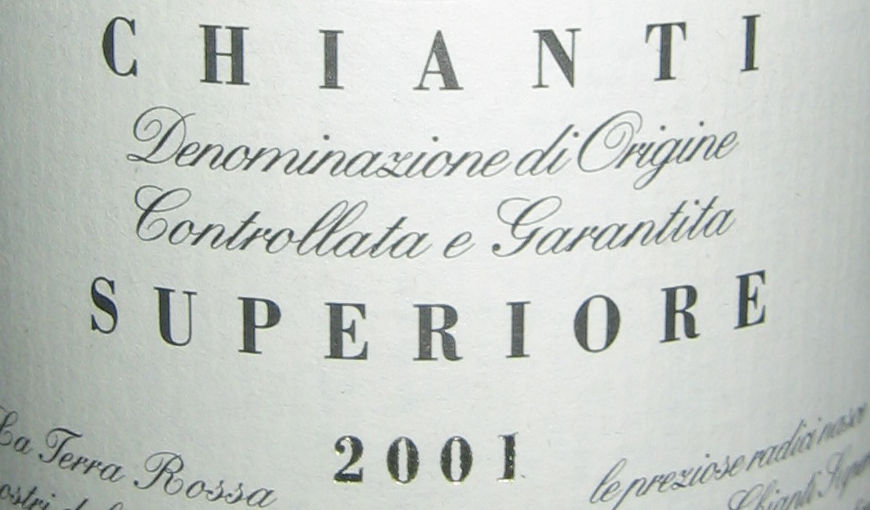
DOCG is the highest designation. It can only be awarded to a wine that has been a DOC for at least seven years and enjoys a special reputation. Controls are stricter, and each bottle bears a numbered state band ( contrassegno di Stato ) on the neck. Important: DOCG guarantees origin and adherence to regulations, but not automatically better taste. A carefully crafted DOC or IGT wine can surpass a DOCG wine; the producer and vintage are crucial.
The 11 DOCG wines of Tuscany
| DOCG | area | wine type |
|---|---|---|
| Brunello di Montalcino DOCG (red wines) | Montalcino (SI) | Red, 100% Sangiovese |
| Carmignano | Carmignano (PO) | Red, Sangiovese with Cabernet |
| Chianti | Provinces of Florence, Siena, Arezzo, Pisa, Pistoia, Prato | Red, predominantly Sangiovese |
| Chianti Classico | between Florence and Siena | Red, at least 80% Sangiovese |
| Elba Areata Passito | Elba-Island (LI) | Sweet red wine from Aleatico |
| Montecucco Sangiovese | Monte Amiata (GR) | Red, Sangiovese |
| Morellino di Scansano | Maremma (GR) | Red, Sangiovese |
| suvereto | Suvereto (LI) | Red |
| Val di Cornia Rosso | Val di Cornia (LI/PI) | Red |
| Vernaccia of San Gimignano | San Gimignano (SI) | White, Vernaccia |
| Vino Nobile di Montepulciano | Montepulciano (SI) | Red, Sangiovese (Prugnolo Gentile) |
You can read more about the wine-growing regions in our article "Wine from Tuscany ," and about white wines in our article "White Wine from Tuscany ." A visit to Montepulciano is perfect for Vino Nobile, and to San Gimignano for Vernaccia.
Chianti or Chianti Classico? The matter of the Black Rooster
Chianti was long synonymous with Italian wine and was traditionally sold in a straw-covered bottle ( fiasco ). Today, there are two separate DOCG wines that are often confused:
Chianti DOCG
Chianti DOCG originates from a large area encompassing six provinces surrounding the historic core region. It is predominantly made from Sangiovese grapes and can be sold under the name of a sub-zone, such as Chianti Rufina, Chianti Colli Senesi, or Chianti Colli Fiorentini. The range extends from simple everyday wines to aged Riservas.
Chianti Classico DOCG
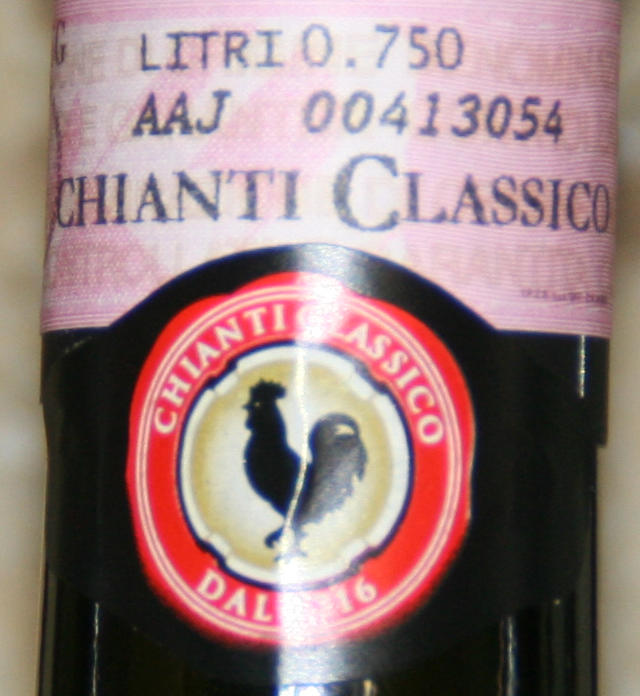
Chianti Classico comes from the historic heartland between Florence and Siena, encompassing towns like Greve, Castellina, Radda, and Gaiole. As early as 1716, Grand Duke Cosimo III de' Medici defined the boundaries of Chianti by decree – one of the first legal regulations governing the origin of wine. The Black Rooster ( Gallo Nero ) was the emblem of the medieval Chianti League; in 1924, the newly founded Consortium adopted it as its symbol. Since 1996, Chianti Classico has been an independent DOCG with its own regulations (at least 80% Sangiovese), and since 2005, every bottle of Chianti Classico has borne the Black Rooster on its label. A Chianti without the "Classico" designation is not permitted to display the rooster.
Chianti Classico is offered in three levels:
- Vintage: The base wine is available for sale at the earliest about one year after the harvest.
- Reserve: Minimum 24 months of maturation, of which at least three months must be in the bottle.
- Gran Selezione: Since 2014, this has been the top category, requiring a minimum of 30 months of aging (three of which must be in the bottle). The rules are being tightened (in the future, at least 90% Sangiovese, only local blending varieties); furthermore, the label may now specify a sub-zone (UGA) such as Panzano or Radda.
Read more about the landscape and the most beautiful wine villages under Chianti in the heart of Tuscany and beautiful places in Chianti.
Frequently asked questions about DOC and DOCG in Tuscany
What is the difference between DOC and DOCG?
Both are controlled designations of origin with defined territories and regulations. DOCG is the higher level: the wine must have been DOC for at least seven years, is subject to stricter controls, and bears a numbered government-issued band on the bottle neck.
Is DOCG always better than DOC or IGT?
No. DOCG guarantees origin and adherence to strict rules, but not automatically better taste. Many famous Super Tuscan wines are classified as IGT.
What is the difference between Chianti and Chianti Classico?
These are two separate DOCG wines. Chianti Classico comes from the historical core area between Florence and Siena, contains at least 80% Sangiovese, and bears the Black Rooster logo. Chianti DOCG comes from a larger area surrounding this zone.
How many DOCG wines does Tuscany have?
Eleven: Brunello di Montalcino, Carmignano, Chianti, Chianti Classico, Elba Aleatico Passito, Montecucco Sangiovese, Morellino di Scansano, Suvereto, Val di Cornia Rosso, Vernaccia di San Gimignano and Vino Nobile di Montepulciano.
What does the black rooster on the bottle mean?
The Gallo Nero is the symbol of Chianti Classico. Since 2005, every bottle of Chianti Classico has featured the rooster on its label.
What is a Super Tuscan?
A mostly high-quality red wine that does not follow the traditional DOC rules, for example through the use of international grape varieties such as Cabernet Sauvignon or Merlot. Many are therefore classified as IGT Toscana.


